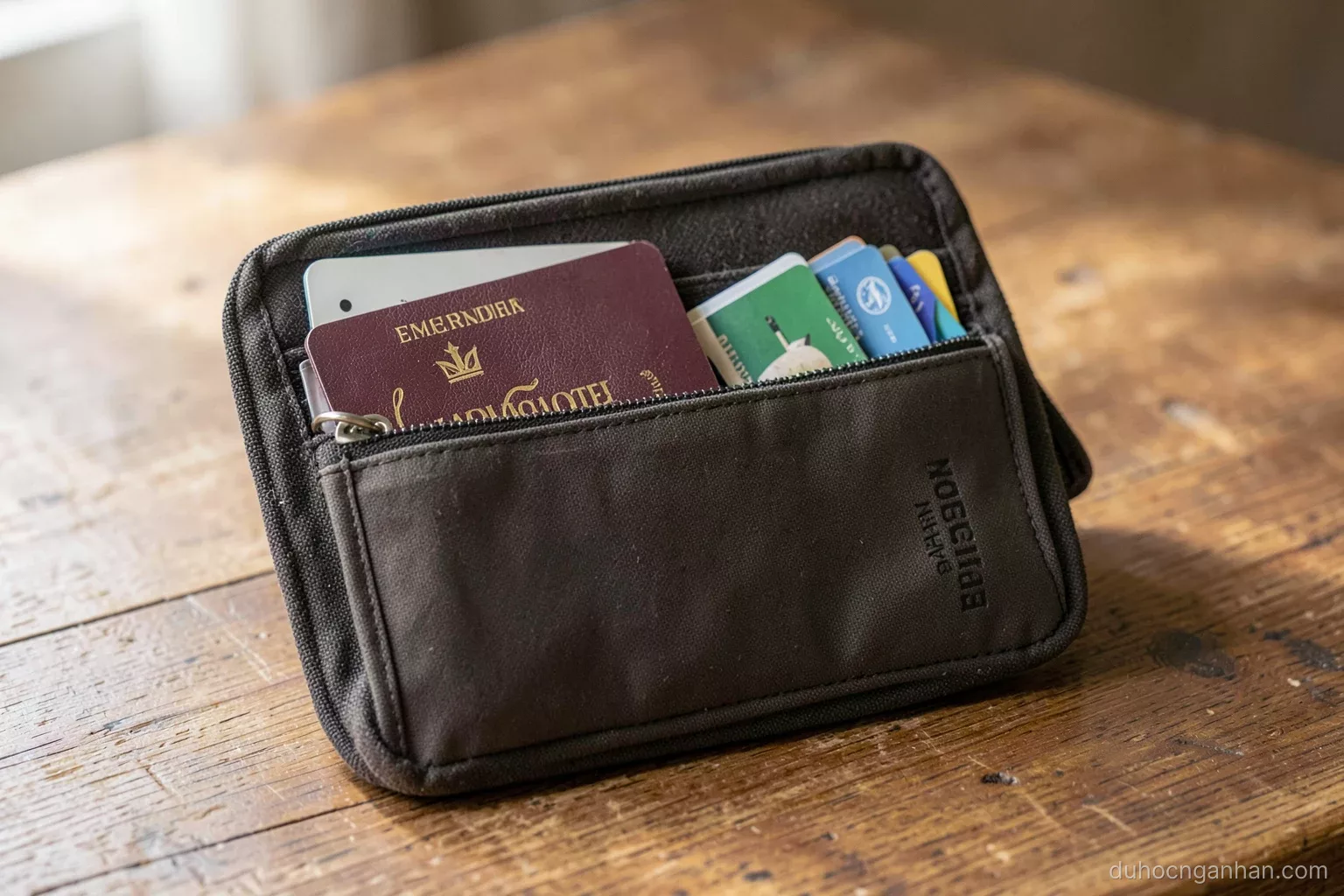
Your child's carry-on document pouch for camp abroad usually contains: a valid passport, a visa or entry permit if the destination requires one, the group's documents (ticket, enrolment confirmation, parental consent letter), copies of those documents, an insurance card and an emergency contact card written in English. In most groups the group leader holds the original passports while travelling and hands them to the camp for safekeeping on arrival; your child keeps the copies and the contact card on them. This split sounds simple, but it only works when all three parties know where each item is at every point of the trip.
The list of required documents depends on the destination, your child's age and who they are travelling with, so always take the list from the organiser and the immigration authorities of both countries as the standard. This article does not replace that list; it is about organising the document pouch so that your child, the group leader and the parents can all find what they need when they need it.
Who holds the passport: your child, the group leader or the camp
For primary and secondary students travelling in a group, the common practice is for the group leader to collect the whole group's passports from check-in at the departure airport, hand them out to each child at departure and arrival control, then collect them again. At the camp, many schools keep students' passports in the office safe and only return them when needed, such as for extending documents or on the return day. This greatly reduces the risk of losing a passport, the hardest thing to replace while abroad. In return, your child needs to know clearly that they are not holding their passport, so that if a stranger asks, they point to the group leader rather than rummaging through their backpack.
Older students travelling alone to an international camp usually keep their own passport on the flight, then hand it to the camp office on check-in. Either way, parents should ask clearly before departure: who holds the passport at each stage, how your child gets it back when needed, and where the camp keeps it. A vague answer is a sign to ask more.
One point often overlooked: passport validity. Many countries require a passport to remain valid for a minimum period from the date of entry or departure, often six months. Children's passports in Vietnam have a shorter validity than adults' passports, so check the expiry date as soon as you start looking at programmes, not in the final month.
A document pouch list in three layers
Dividing documents into three layers helps everyone know what they are holding. The list below is a general framework; the organiser will add the programme's own documents.
- The originals layer (held by the group leader or the camp): passport, visa or entry approval letter if any, parental consent or authorisation letter as required by the destination and the airline, the camp's enrolment confirmation letter.
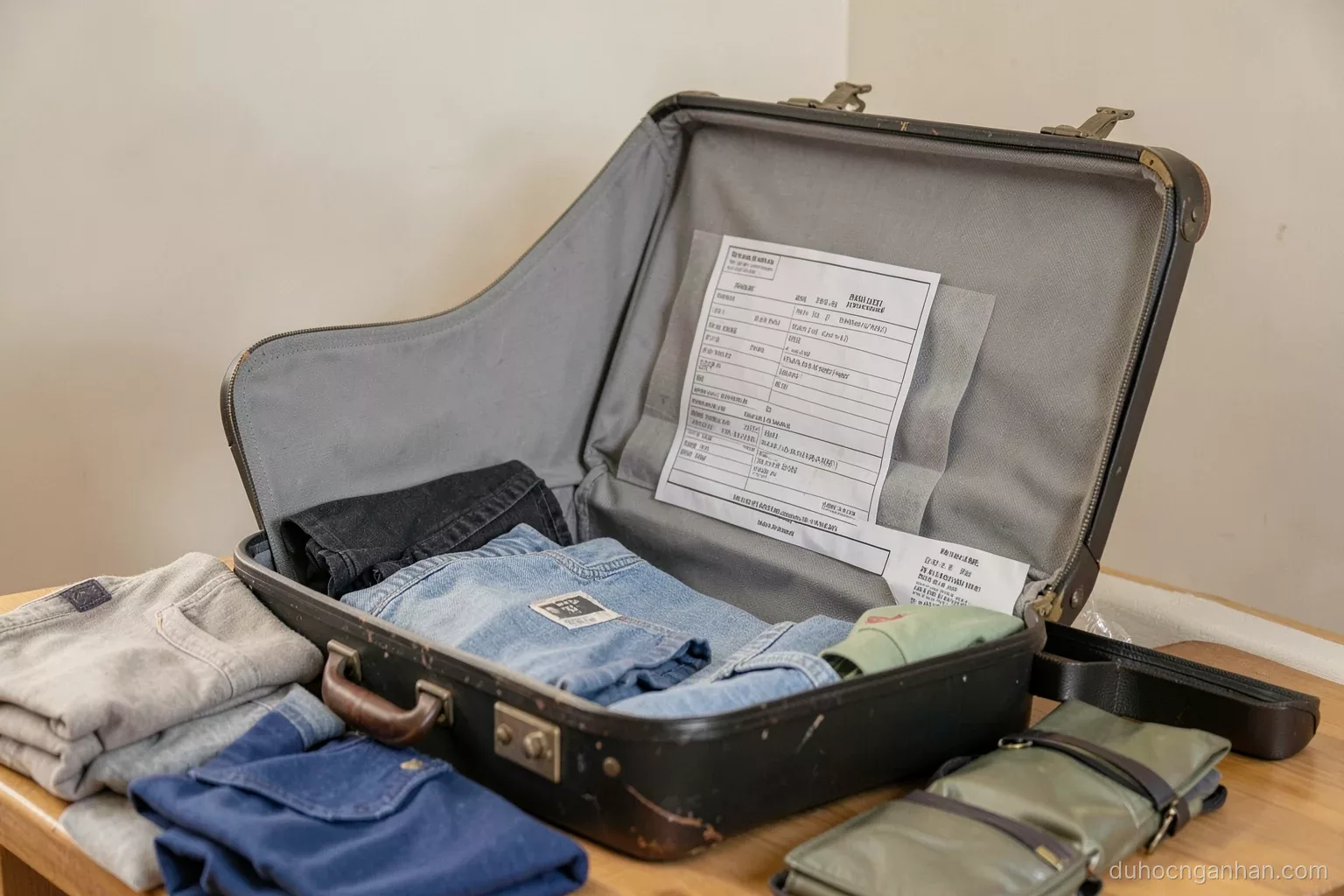
- The copies layer (kept by your child in the cabin bag): copies of the passport information page and visa, a copy of the parental consent letter, the insurance certificate, the emergency contact card, and two spare passport photos.
- The digital layer (saved on the parents' and group leader's phones and in a private email account): clear photos of every document, e-tickets, the contract with the organiser, the insurance policy, and the medical form submitted to the camp.
- Medical documents (if any): a summary of medical history in English, prescriptions, a doctor's letter for medicines your child must carry, and the vaccination record or its translation if the camp requires it.
Copies cannot replace originals at the border, but they help a great deal when reporting a loss, getting replacement documents from the Vietnamese diplomatic mission in the destination country, or when a hospital needs your child's details while the passport is in the camp office safe.
The emergency contact card: what to write and where to keep it
The emergency contact card is a piece of paper the size of a bank card, laminated or kept in a plastic sleeve, written in English. It is for situations where your child gets separated from the group at an airport, shopping centre or sight, their phone battery is dead, and they need a stranger's help to make contact. Panicking children often forget even their mother's phone number; the card speaks for them.
The card should include: your child's full name as on the passport, the camp's name and address, the phone numbers of the group leader and the camp office with country codes, a parent's number with the Vietnam country code, any allergies or conditions to be aware of, and a short, polite English sentence saying that your child is a student at the camp and asking the reader to call the group leader's number. The sentence is written out so your child does not have to work out what to say while panicking; they just hand over the card.
Do not write your home address in Vietnam or your child's ID number on the card. Keep the card in a trouser pocket or an easy-to-reach backpack pocket, not together with the passport. Make two cards: one in the daily backpack and one in the cabin bag for the flight. Before the trip, practise with your child: if you lose the group, stand still somewhere easy to see, find a uniformed staff member or an information desk, and show the card.
Document pouches: which type to choose for your child
A good document pouch is one your child does not forget to open, does not forget to close and does not leave on a seat. Each type has its own strengths, and many groups combine two: a neck pouch for the airport stages and a flat zip pouch once at camp.
| Type of pouch | Advantages | Things to note | Suits |
|---|---|---|---|
| Flat zip pouch kept in the backpack | Compact, waterproof, contents visible | Easily mixed up with other pouches, needs a distinctive colour | All ages, especially young children |
| Neck pouch under clothing | Always on the body, hard to pickpocket | Hot in tropical countries, awkward at security | Crowded travel stages, long transits |
| Small cross-body bag | Quick to reach when documents must be shown | Easily taken off and left on a seat or in a toilet | Older students, travelling alone |
| The group's document folder | Uniform, easy for the group leader to check | Your child cannot manage it themselves | Groups of primary school children |
Whichever pouch you choose, teach your child one habit: every time they stand up from a seat in a waiting area, touch the document pouch and the phone. This three-second habit saves more trips than any expensive pouch. Practise it at home, in restaurants and at the cinema in the weeks before the flight, so that at the airport your child's hand does it automatically without reminders.
If your child or the group loses a passport abroad
Losing a passport is not the end of the world, but it takes time. The usual sequence is as follows, and it is also why document copies matter.
- Your child tells the group leader or the camp office straight away and does not go searching alone in a crowded place.
- The group leader goes with your child to report it to the police or the competent authority where it was lost, to get a report or certificate of loss.
- Contact the Vietnamese diplomatic mission (embassy or consulate general) in the destination country to get a replacement document for a citizen under 18; the mission will advise on the application, which usually requires photos, a copy of the old passport, the loss report and the parents' documents.
- Inform the airline and the organiser so tickets can be adjusted if processing the documents runs into the group's return date.
- Parents at home prepare scans of the birth certificate, the parents' ID cards and other documents as instructed, and email them when asked.
The specific procedure and processing time are decided by the diplomatic mission, so there is no figure to promise in advance. What the family can do is have copies and photos ready and know the mission's number, so no extra days are lost for lack of documents.
Documents on the way home: what is most easily forgotten
The way home is usually more chaotic than the way out: your child is tired, the suitcase is full, and there are emotional goodbyes with friends. This is when documents are often left in a dormitory desk drawer or the office safe. A day before leaving camp, the group leader usually checks the whole group's passports again; your child should also check their own document pouch: are the copies still there, is the contact card still there, where are the certificate of completion and the learning report.
The camp's certificate and report should go in a stiff folder in the cabin bag, not stuffed into the checked suitcase, because paper creases easily and the suitcase may arrive late. Some families photograph these documents as soon as they receive them, to make sure there is a copy if the paper gets damaged.
Back in Vietnam, do not throw away the copies and the contact card straight away. Keep them in an envelope labelled with the name of the trip; if your child goes again next season, much of the information can be reused and parents only need to update it.
Preparing documents with your child, not for your child
Parents often do all the paperwork themselves for fear their child will get it wrong. But a short trip abroad is a good opportunity for your child to understand their own documents: what a passport is for, why copies must be kept, whom to look for when something happens. Children who understand the reasons look after things more carefully than children who are simply told "don't lose it".
One evening before the flight, sit with your child, open the document pouch, read out each item inside, and let your child copy the camp's name and contact numbers onto the emergency card by hand. Ask your child a few scenarios: what do you do if you lose the group at the airport, who holds your passport once you reach camp, if your phone battery dies, where do you find mum's number? If your child can answer, the family can feel much more at ease.
The Du Học Ngắn Hạn advisory team sends families the list of required documents for each programme and country, with the parental consent template currently in use, at registration; parents should ask directly if the purpose of any document is unclear.
Frequently asked questions
Does a child travelling with a group need an authorisation letter from their parents?
It depends on the rules of the destination, the airline and your child's age. Many countries and airlines require a parental consent letter when a child under 18 travels without their parents, sometimes certified or translated. The organiser will provide the specific template; also check the website of the destination's immigration authority.
Should my child hold their own passport for the whole trip?
For children under about fourteen, it is best for the group leader or the camp to hold the passport, with your child keeping a copy. Older students travelling alone can hold their own on the flight and then hand it to the camp on arrival. What matters is agreeing in advance who holds it at each stage, so that nobody assumes someone else has it.
Does the emergency contact card need to show blood type?
It is not essential. The most important information on the card is the name, the camp's name, the contact numbers and any allergies or conditions to be aware of. A hospital will run its own tests if needed. If your child has a condition that needs urgent treatment, such as a severe allergy, state it clearly and add a doctor's letter to the document pouch.
Do document copies need to be notarised?
Copies for your child to carry during the trip usually do not need notarising; they are for looking up information and helping when reporting a loss. Documents that must be submitted to government authorities or the camp should follow the recipient's instructions exactly, which may require certification or translation.
Is it safe to keep photos of documents on my child's phone?
There is a risk if the phone is lost without a screen lock. It is better to keep digital copies on the parents' and group leader's phones and in a private email account with a strong password. If you store them on your child's phone, set a screen lock and teach your child not to lend the phone without locking the photo app.
Do children under 18 going to the Philippines need any specific documents?
The Philippines has specific rules for children under 15 entering without their parents, usually referred to as a waiver for minors, submitted at the port of entry or through the organiser. The rules and fees may change, so check with the Bureau of Immigration of the Philippines and the organiser before the trip.