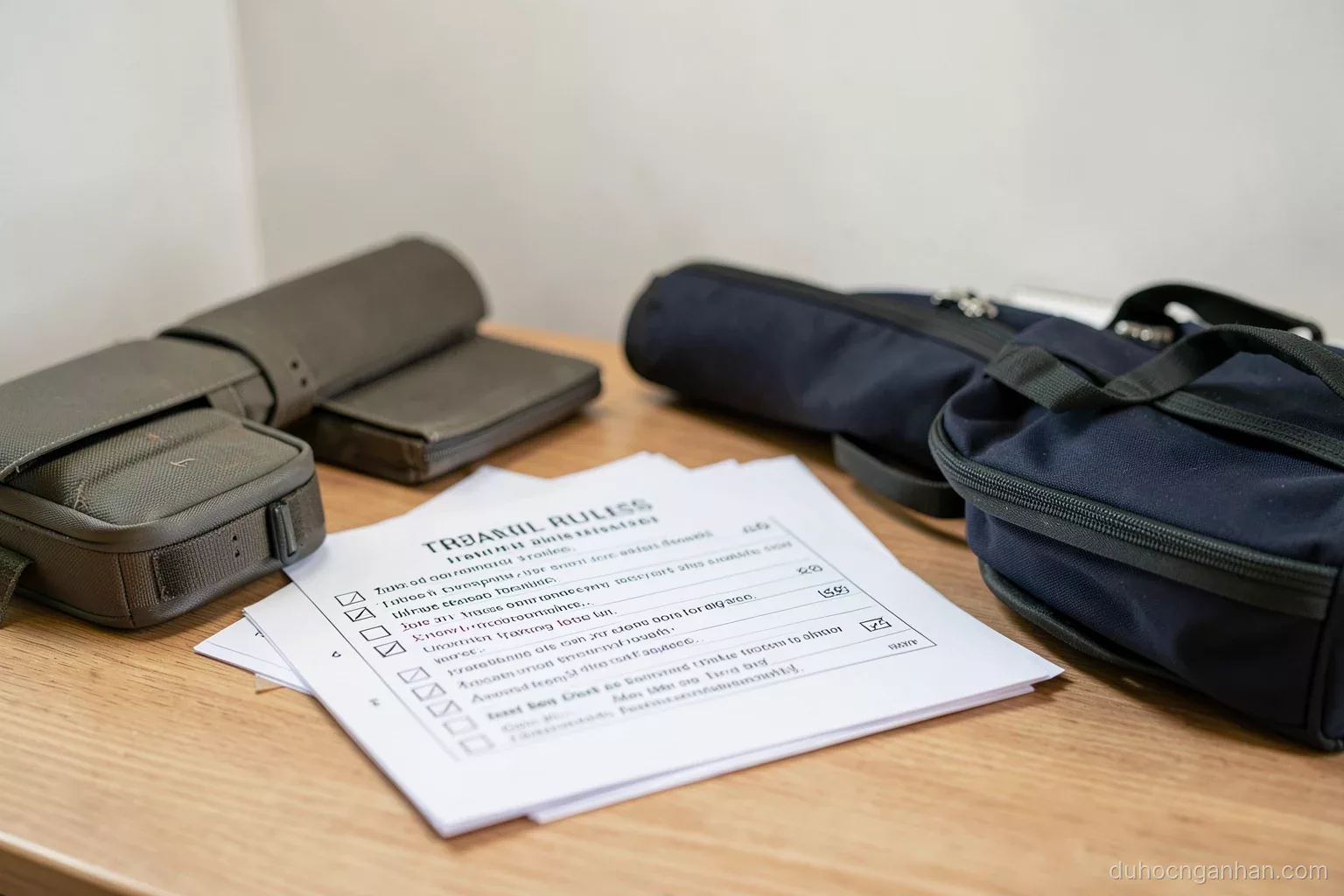
Group rules are a short set of rules the organiser sets for the students travelling with it, applying when the group is on the move, at airports and on outings away from the camp: always go in pairs or small groups, be present at every headcount, return on time, never leave the group without permission, and tell an adult when something happens. They are different from the camp's rules, which govern life on the campus such as class times, bedtimes, phones and rooms.
Group rules work when there are few of them, they are clear, and children understand why they exist. This article goes through the common rules, the reasons behind each one, how groups handle breaches, and how parents can talk to their child before departure so the child keeps them willingly.
How group rules differ from camp rules
While your child is on the camp's grounds, the camp's rules apply: getting-up time, class times, lights-out, phone rules, which areas are allowed. The camp's boarding staff remind children and handle breaches. When your child goes out, such as at the airport, on the coach, on weekend excursions or a trip to the supermarket, another layer of rules sits on top: the group's rules, enforced by the group leader.
The two sets usually do not conflict, but they do differ in places. The camp may let older students walk around the town in groups without an adult; the group's organiser may be stricter and not let its own children do that. When there is a difference, the stricter rule usually applies, and parents need to know in advance.
Ask the organiser at the group meeting: when do the group's rules apply, when do the camp's rules apply, and if they differ, which one is followed.
Five common rules and the reasons behind them
Always go in pairs or small groups. Each child has a buddy; the two always know where the other is. When one child goes missing, the first to notice is the buddy, much sooner than the next headcount. This is the oldest and most effective rule for any group of children.
Be present at every headcount. Headcounts happen every time the group changes place: getting on the coach, getting off, entering a sight, before leaving. Children answer by number or by small group. It takes a minute each time, but it is the only way to know for certain the group is complete.
Return to the meeting point on time. When the group lets children have free time in a limited area, such as the food court of a shopping centre, the meeting time is sacred. One child ten minutes late keeps the whole group waiting and forces the group leader to send people to search.
Never leave the group without permission. Not even to buy a drink, use the toilet or take a photo on the other side. Children tell an adult, or at least tell their buddy and go with them.
Tell an adult when something happens. Pain, tiredness, lost belongings, a stranger striking up a conversation, seeing a friend in trouble: report it immediately, do not put up with it and do not try to handle it alone. Children need to be told clearly that reporting is not telling tales and they will not be told off.
Headcounts: a small task that decides the whole group's safety
To an outsider, a headcount looks simple. A group leader knows it is the most important task of the day. With a large group moving between many places and children mingling with other visitors, counting by eye is very error-prone. That is why many groups use numbers: each child has a number, and at a headcount the children call out their numbers in order, so a missing number shows immediately.
Another method is to split the group into small groups of four or five, each with a captain who is one of the older or more responsible children. The group leader only needs to ask the captains "is your group complete?". This is faster and gives older children a role.
The most important headcount is before leaving a place, not on arrival. Groups that leave a child behind at a sight usually do so because the last count was skipped while everyone was rushing onto the coach.
Curfews and phones on outings away from camp
Organisers set different levels by age. The table below shows common types of rule, so parents can picture them and ask which one their child's organiser uses.
| Age group | Going out of camp | Return time | Phones on outings |
|---|---|---|---|
| Aged 8–11 | Always with an adult accompanying the group | According to the group schedule, usually before dinner | Usually left at camp or held by the group leader |
| Aged 12–14 | Small groups with an adult, sometimes free time within a limited area | According to the group schedule | Carried, used to contact the group leader |
| Aged 15–17 | May go out in groups of three or more within permitted areas, with parents' written consent | A specific time, earlier than lights-out | Must be carried, fully charged, with the ringer on |
For older groups, if the organiser offers limited free time, parents are usually asked for consent in advance. That is the family's decision; parents can say no, and their child will then go with an adult-led group like the younger children.
Specific rules at the beach, the pool and in crowded places
Many of the camp's weekend outings are to the beach, water parks or crowded amusement parks. These are places where the group needs stricter rules than usual. At the beach and the pool, children only go into the water when a lifeguard is on duty and an adult from the group is watching from the side; no going in after dark, no swimming beyond the flags or buoys, and no going in straight after a big meal or when tired.
At amusement parks, the group agrees an easy-to-spot meeting point, tells the children as soon as they arrive, and repeats the return time. Children go in small groups with an adult or a captain; phones are fully charged with the ringer on. If they get separated, children go straight back to the meeting point and wait there.
Parents who know their child is a weak swimmer should tell the group leader at the group meeting. It is nothing to be ashamed of; it is information that helps adults make arrangements so your child can still have fun safely.
The role of older children in the group
In groups with children aged from eight to seventeen, older children are often given the role of captain: reporting the number in their small group, reminding younger children of meeting times, and noticing anyone who seems tired or sad. This helps the group leader a great deal, and helps the older children grow up during the trip.
But being a captain does not transfer adults' responsibilities to children. Older children are not responsible for younger children's safety, do not handle incidents alone, and are always told to report to an adult when something happens. A good group leader asks the children before giving them the role, and thanks them publicly at the end of the trip.
Parents of older children should talk to them about this role in advance: helping younger children is a way of contributing to the group, but your child is still a student, still has the right to enjoy themselves and is still cared for by the adults.
Serious breaches that usually lead to being sent home
Each camp and organiser has its own list, set out in the rules and the contract, but the breaches below are treated as serious almost everywhere and can lead to the child being sent home early, at the family's expense:
- Leaving the camp or the group without permission, especially at night.
- Alcohol, cigarettes, e-cigarettes or prohibited substances.
- Bullying, fighting or harassing others, including by message and on social media.
- Entering the rooms of students of the opposite sex or off-limits areas.
- Taking other people's belongings or damaging camp property.
- Repeatedly ignoring adults' safety instructions after being reminded.
Read this list with your child before departure, and explain clearly why each breach is treated as serious. With teenagers, explaining the reasons (their own safety, their friends' safety and the laws of the destination country) works far better than threats.
Minor breaches: how groups usually handle them
Most breaches over a camp season are minor: arriving at the meeting point a few minutes late, chatting after lights-out, using a phone outside permitted times, not sticking with a buddy in a rush. A skilled group leader handles these gently: a private reminder, explaining the reason again, and sometimes a small, related consequence such as walking next to the group leader on the next outing.
Minor breaches are usually not reported to the family if they happen only once. If they are repeated, or if the group leader sees that your child is going through something, such as sadness or a falling-out with a friend, they will tell you privately so you can talk to your child together.
Parents who hear that their child has broken a rule should listen to the group leader's account, then talk to their child calmly. Scolding a child over the phone while they are far away usually only makes them sadder and more distant, and does not help them behave differently.
Talking about the rules with your child before departure
The best way for your child to keep the rules is to understand and agree with them beforehand. Sit with your child, read the group's rules, and ask why they think each one exists. Children often come up with the right reason themselves. With younger children, you can role-play: "if you're in the supermarket and can't see your buddy, what do you do?".
Agree with your child on anything else the family expects beyond the group rules: calling home on schedule, how to spend money, what not to buy. Make it clear that if something happens, even something that is their own fault, they can always tell the group leader and their parents, and that matters more than getting a warning.
Finally, talk to your child about trust: the trip is a time when parents trust them to be grown-up enough to be away from home, and keeping the rules is how they show that trust is justified. For many children, the feeling of being trusted is a stronger motivation than any punishment.
Frequently asked questions
My child is older; do they still need the buddy rule?
Yes. In an unfamiliar place with an unfamiliar language, even adult tourists usually stay in groups. The buddy rule is not because we think your child is not grown-up, but because it is the simplest way to notice early when someone has become separated from the group.
If my child is sent home for a breach, who brings them home?
It depends on the organiser and your child's age. Young children usually need an adult to fly with them, either a member of the organiser's staff or a parent who comes to collect them. The extra costs are usually borne by the family. Ask carefully about this clause in the contract before departure.
Can the group leader search my child's belongings?
Some camps have rules on searching rooms or luggage when prohibited items are suspected, usually with a witness present. Parents should read the rules on this and tell their child in advance, so they are not surprised or offended if it happens.
What if my child does not like the buddy they have been paired with?
Your child tells the group leader and explains why. Many groups change buddies after a few days once the children know each other better. Not getting on is not a reason to abandon the buddy rule, but it is a legitimate reason to ask for a change.
Do the group rules apply when parents visit?
When parents take their child out by arrangement with the camp, responsibility during that time passes to the parents. Tell the group leader and the camp in advance, sign the collection and return form if the camp requires it, and bring your child back at the agreed time.
Should I give my child extra family rules?
Yes, but only a few, and none that conflict with the group rules. Two or three things that matter most to the family, such as how to spend money or the call schedule, are easier to remember than a long list.