When travelling with a group, your child enters the destination country through three layers: an advance declaration if the country requires one (usually an online declaration in the few days before arrival), passport control, and then customs and quarantine after collecting luggage. The group leader travels with the group and holds the group's shared documents, but border officers may question each child individually, and your child's personal documents must be correct, complete and consistent with each other.
Entry rules change from country to country and from year to year. This article does not replace checking the official website of the destination's immigration authority and its embassy in Vietnam; it helps parents understand how entry is structured, which documents are often asked for with minors, and which parts are the family's job.
Layer one: the declaration before the flight
More and more countries ask travellers to declare information online before arriving: itinerary, accommodation, health status, items carried. For example, according to information published up to 2026, the Philippines uses the eTravel online declaration system, Singapore uses the SG Arrival Card, and Japan has the Visit Japan Web portal for immigration and customs procedures. Each system has its own deadline, usually within a few days before arrival.
For a student group, the question is who makes the declaration. Some organisers declare for the whole group using the information parents have sent; others ask each family to declare and send the confirmation code to the group leader. Either way works, as long as it is clear who does it and by what date.
If the family is declaring, do it on a computer at home, check every field against your child's passport, and use only the official government website of the destination country. Some intermediary sites look like the official one and charge fees for something that is free; check the domain against the information on the embassy's website.
After declaring, save the confirmation code or QR code the system returns, take a screenshot and send it to the group leader. At some airports the airline checks this code at the check-in desk in Vietnam; without it, your child may have to declare again on a phone on the spot while the whole group waits.
Layer two: passport control
At passport control, officers check the passport, the visa or visa exemption, may take a photo and fingerprints, and ask a few short questions: why you are here, how long you are staying, where you are staying, who is meeting you. With student groups, the group leader usually goes first or alongside, holding the camp's confirmation letter, the group list and the shared documents.
Many border points let a group go through one counter together, but not everywhere. In some places each child has to stand at the counter alone. Your child should practise answering three simple questions in English: I am here to study at a summer camp (the camp's name), I am staying for so many weeks, I am travelling with a group and that person is my group leader. A short, accurate answer that matches the documents is enough.
Tell your child not to joke around in this area, not to take photos and not to use their phone while standing at the counter. In many countries photography in the passport control area is prohibited, and an innocent joke can lead to the whole group being held for further questions.
Documents often asked for with minors travelling without parents
Many countries have specific rules for children under a certain age entering without their parents, to prevent trafficking and unlawful removal of children. Depending on the country, you may be asked for:
- A consent letter from the parents or legal guardian allowing the child to travel, stating the trip, dates and accompanying adult; some places require both parents' signatures, some require notarisation, some require a translation.
- A copy of the birth certificate to prove the parent–child relationship, with a translation if the destination requires it.
- A confirmation letter from the camp or school your child is going to, stating who is responsible for caring for your child during their stay.
- A specific document issued by the destination country for children travelling without parents. For example, the Philippines has a Waiver of Exclusion Ground procedure for children under 15 entering without their parents; organisers usually guide families through it, and parents should check the current requirements with the Bureau of Immigration of the Philippines or the Philippine Embassy in Hanoi.
- Copies of the parents' passports and their contact details, in case officers want to call to verify.
The list above covers common types of document, not the compulsory list for any particular country. The organiser must send the correct list for your child's destination; parents should check it against that country's official website and note the date they checked. Leaving Vietnam also has its own requirements for minors; ask the organiser and check the information from the Immigration Department (Ministry of Public Security) and the airline's requirements.
Layer three: customs and quarantine
Food is the item most often confiscated. Many countries have strict quarantine rules on meat, eggs, dairy, fruit, seeds and home-made food. Dry food packaged by a manufacturer usually gets through more easily, but must still be declared if the destination requires it. When unsure, declare; if declared items are confiscated you lose the items, but undeclared items that are found can lead to a fine.
Medicines need a prescription or a doctor's letter. Some active ingredients that are common in Vietnam are controlled in other countries. Keep your child's medicines in their original packaging with a prescription or doctor's letter, ideally with an English version. Ask your doctor about any narcotic or psychotropic medicines your child is taking.
Cash. Each country has a threshold above which cash must be declared on entry. Students' pocket money is usually far below it, but if the group leader holds money for the whole group, the total may exceed the threshold. The organiser needs to plan for this.
Items carried for others. Tell your child never to agree to carry anything for a stranger, even someone who seems kind at the airport. Your child must know what everything in their suitcase is.
When a border officer holds a child back for more questions
Occasionally a child is asked to go to a secondary inspection room for further questions: documents with a detail that does not match, a name that matches someone in the system, or just a random check. For a child, this is a frightening experience if nobody explains what is happening.
An experienced group leader will ask to go with that child, or at least stay close and present the group's documents. The assistant leader keeps the rest of the group in one place. The child being questioned needs to know: answer truthfully and briefly, say "I don't understand" if they do not understand a question rather than guessing, and hand over documents when asked.
If the questioning takes a long time, the group leader informs the organiser in Vietnam and the child's family. Parents should keep their phone on and be ready to send extra documents if asked. In most cases the matter is resolved within a few hours once the documents have been supplemented.
Practise with your child at home
Fifteen minutes of practice at home makes your child much calmer at the border. A parent plays the officer and asks short questions in English: the purpose of the trip, how long, where, who with, what is in the bag. Your child practises answering briefly, looking at the person asking and speaking slowly. If your child's English is not yet confident, practise the sentence "I am with a group, please ask my group leader" while pointing to the accompanying adult.
Also practise taking out the passport, opening it at the photo page, handing it over and putting it back in the right place. It sounds simple, but a nervous child after a long flight can easily rummage through their bag, drop documents or forget to take their passport back from the counter.
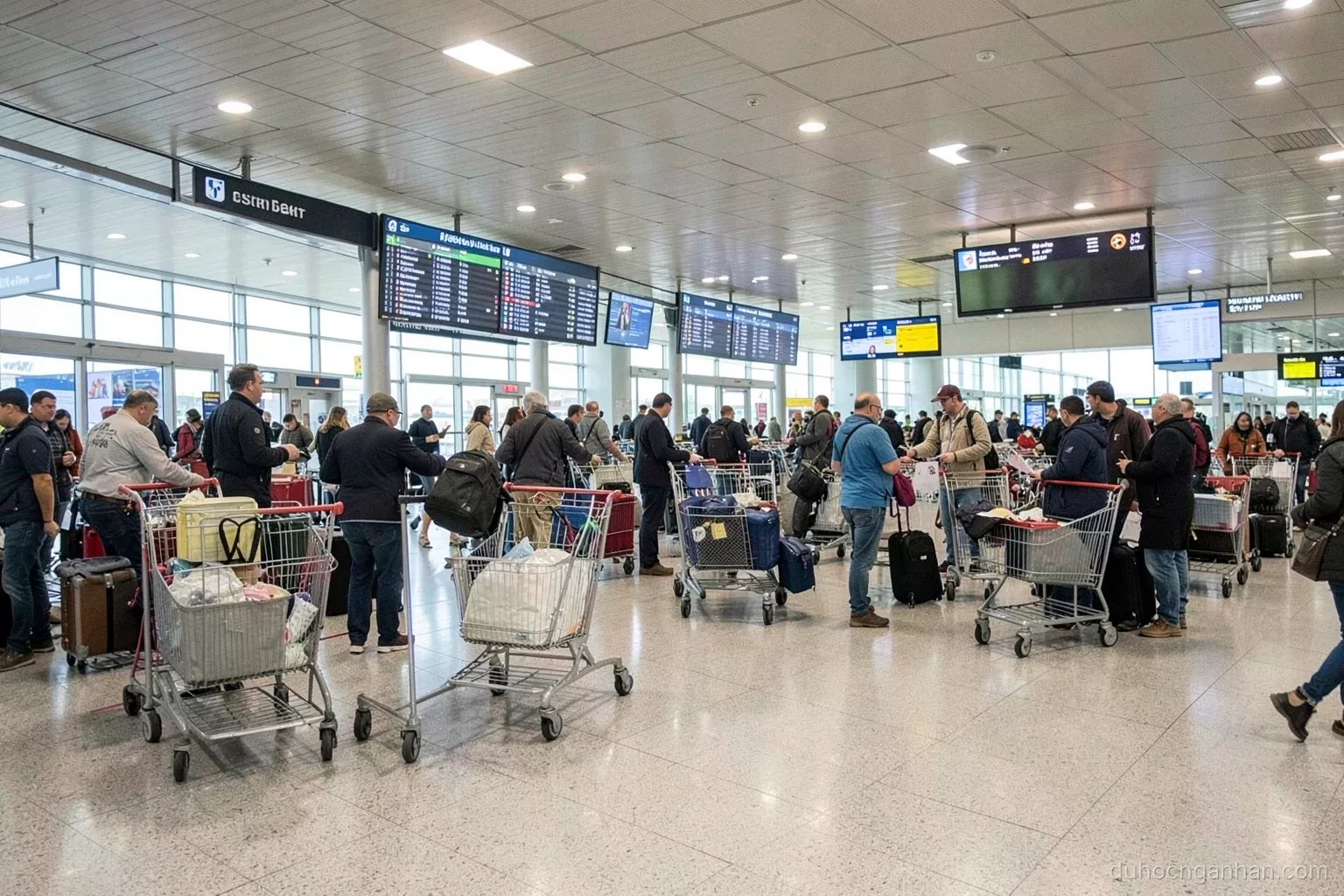
Finally, show your child photos of the arrivals area of a large airport and explain the usual signs: the line for citizens of that country, the line for foreigners, baggage reclaim, and the customs channels for goods to declare and nothing to declare. A child who knows where they are in the sequence panics less when the group has to split into different lines for a while.
Leaving the arrivals area: meeting the camp's staff
After customs comes the arrivals hall, where people are waiting to meet travellers. The camp usually sends staff holding a name board or wearing the camp's T-shirt. The group leader gathers the whole group in one place inside the controlled area before going through the final door, because once you are out in the arrivals hall it is crowded and you cannot go back in.
In the hall, the group leader confirms that the person meeting them really is from the camp, using the details exchanged in advance: name, phone number, group code. Tell your child not to go with anyone claiming to be there to meet them unless the group leader has confirmed it, even if that person calls your child by name.
Once the group is on the coach, the group leader does the last headcount of the airport stage and posts in the parents' chat. At this point entry is complete; what remains is the drive to the camp and the first evening, when the children are tired but usually very excited.
Parents' tasks before the flight
Most risks at the border can be dealt with from home. Check your child's passport validity against the destination's requirements, as many countries require a passport to remain valid for a certain period after the departure date. Check that the name on the ticket, the enrolment letter, the consent letter and the online declaration matches the passport exactly. Check whether the consent letter has all the signatures required, and whether it needs notarising or translating.
Prepare two sets of copies: one for the group leader and one for your child to carry in the cabin bag, kept separate from the originals. Save photos of them on both the parents' and the child's phones.
Finally, write down the date you checked the destination's rules and where you checked them. If something changes close to the flight, the family knows how current its information is.
Frequently asked questions
Does my child need their own visa when travelling with a group?
Each student needs their own visa or visa exemption according to their passport; travelling with a group does not replace a visa. Some countries have group visas, but they still list each person by name. Ask the organiser and check on the destination's embassy website.
Is there a fee for the online arrival declaration?
Government declaration systems are usually free or state the fee clearly on the official website. If a site asks for payment for something the embassy website says is free, it may be an intermediary site; check the domain before entering any information.
Does the parental consent letter need to be signed by both mother and father?
It depends on the destination and the airline. Many places recommend both parents' signatures, or proof of custody if only one parent signs. Ask the organiser which template it uses and who has checked that template against the destination's requirements.
Can my child take a phone or tablet through the border?
Yes, like any other passenger. In some countries, officers have the right to inspect electronic devices. Tell your child not to store sensitive content, not to carry other people's devices, and to charge the battery fully before flying.
What if my child's documents are incomplete at the border?
The group leader will explain the situation and contact the family to send copies of anything missing. In some cases entry is allowed once the extra documents are provided; in others it is not. That is why every document needs to be checked carefully before the flight, not at the border.
Should my child carry their birth certificate?
For children travelling without parents, carry a copy of the birth certificate, with a translation if the destination requires one. It proves the relationship between the child and the person who signed the consent letter, and is often asked for in countries that check minors closely.