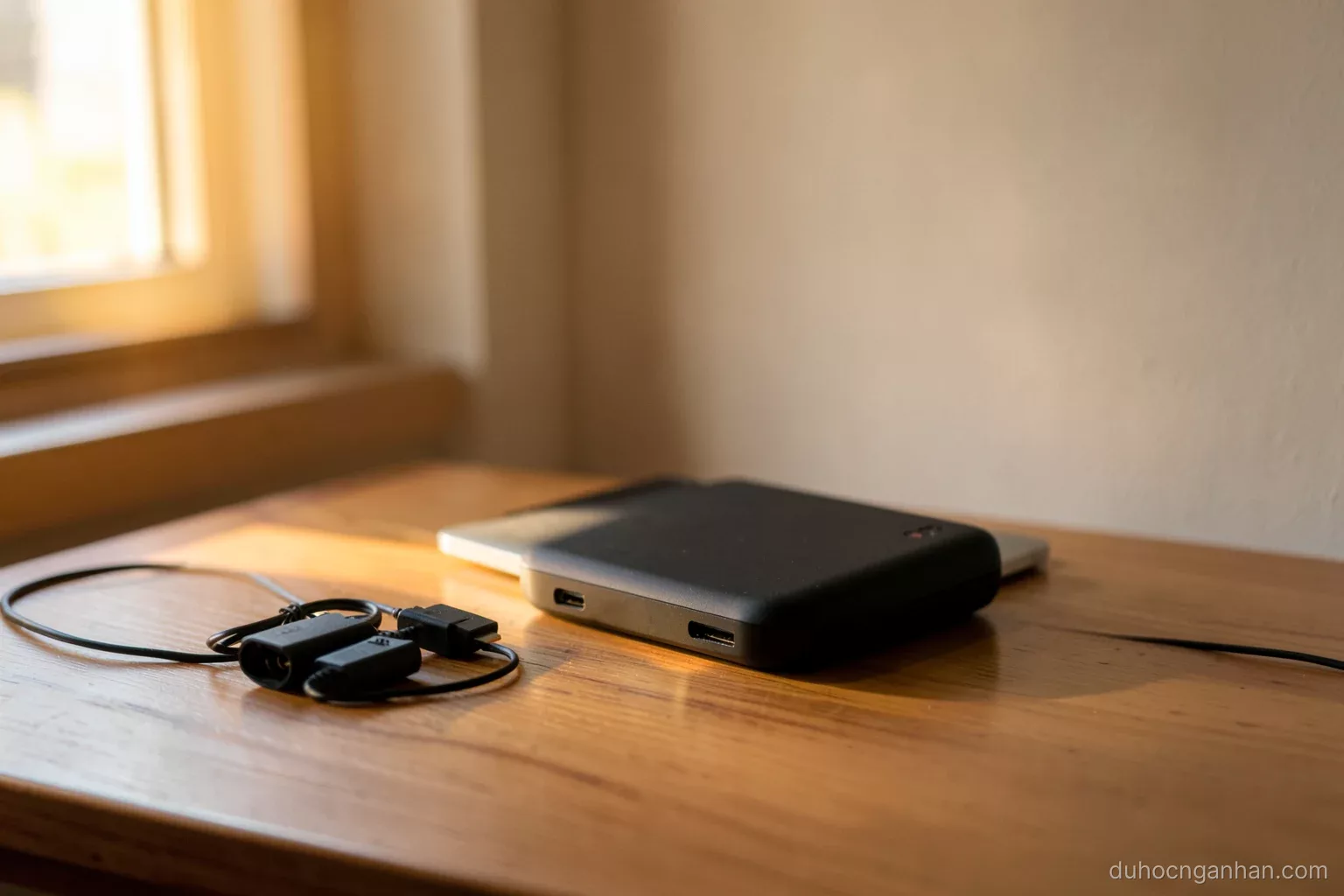
For camp abroad, your child's electronics usually only need to be: a phone and charger, a moderate-capacity power bank carried in the cabin bag, a plug adapter suited to the destination, headphones, and a tablet or laptop only if the programme requires one. Power banks and loose lithium batteries must not go in checked luggage; many airlines also restrict using or charging them in the cabin.
Fewer electronics means fewer things to lose, fewer arguments with the camp's phone rules, and more time for friends. Calling home and SIM cards are covered in a separate article in the language study guide; this one focuses on packing, flight safety and using electricity in the dormitory.
What to take, and why to take little
Most residential camps manage phones by the clock: collected during lessons, returned at break or in the evening, and in some places only allowed a few times a week. That means your child uses devices much less than at home. Taking three or four devices at once only adds to the work of looking after and charging them, and to the risk of losing them.
A minimal kit for primary and secondary students is usually: one phone, one charger, a spare cable, a plug adapter and a pair of wired headphones. Older students might add a laptop if their course requires work on a computer, or an e-reader if they love reading. Handheld game consoles, Bluetooth speakers and expensive smartwatches usually cause more trouble than they are worth.
Before packing any extra device, ask one question: at camp, when will your child use it, for how long, and who looks after it when they are not using it? If there is no answer, it should stay at home. Many children come back saying an old phone and a notebook were enough, while the tablet sat in the wardrobe for almost the whole trip.
Power banks: the item most often stopped at the airport
Power banks contain lithium batteries, which can heat up and catch fire if damaged or knocked. That is why aviation rules require power banks and loose batteries to be carried in cabin baggage, not packed in checked suitcases. A suitcase with a power bank inside may be called back for inspection, sometimes making your child late for boarding.
Capacity is also limited, measured in watt-hours (Wh), not mAh. A rough conversion is to multiply the mAh figure by the voltage printed on the casing (usually about 3.7 V) and divide by 1,000. As a hypothetical example, a 10,000 mAh power bank at 3.7 V is about 37 Wh. Most airlines allow power banks under 100 Wh without permission; higher capacities come with their own conditions. A child going to camp does not need a big power bank; a compact one is enough.
Many airlines, especially in Asia, now ban using or charging power banks throughout the flight and only allow them to be carried. The rules change quickly, so check the airline's website before the trip and tell your child to follow the cabin crew's instructions. Choose a power bank with its specifications still legible on the casing, not swollen or cracked; power banks without a clearly marked capacity are often confiscated.
Sockets and voltage in some common camp destinations
Most phone, tablet and laptop chargers today accept 100 to 240 V, so you only need an adapter with the right type of pins. Devices that only run at one voltage, such as hairdryers and curling irons, are a different matter. The table below is a general reference; check it for the place where the camp is located.
| Destination | Common plug type | Voltage | Notes |
|---|---|---|---|
| The Philippines | Flat US-style pins, some sockets take round pins | 220 V | Many dormitory sockets only take two flat pins; bring an adapter to be sure |
| Singapore, Malaysia, the UK | Three large rectangular pins | About 230 V | An adapter is almost always needed |
| Australia, New Zealand | Three flat pins in a V shape | About 230 V | Needs an adapter for this specific type |
| The US, Canada | Flat pins | 120 V | A Vietnamese 220 V hairdryer runs weakly or not at all |
| South Korea, most of Europe | Two round pins | About 220–230 V | Vietnamese round-pin plugs usually fit, though thicker pins sometimes do not |
A compact universal adapter that works in many countries is a convenient choice if your child will be travelling elsewhere too. Choose one with a fuse, solidly built, whose pins do not wobble when plugged in.
Using electricity safely in the dormitory
Dormitory rooms usually have few sockets, and several children charge their devices in the evening. That is when overloaded sockets, poor-quality extension leads and devices charging on beds or under pillows become a problem. Many camps completely ban extension leads brought from outside, hotplates, kettles and high-power hairdryers for fire safety reasons.
Tell your child a few simple things: do not charge on the bed, on the duvet or under the pillow; do not use charging cables with cracked casing or exposed wires; unplug chargers when full and when leaving the room; if a device gets unusually hot, swells or smells of burning, unplug it immediately and tell the boarding staff. Children often ignore these things when parents say them at home, but at camp they are rules, and breaking them can earn a reminder in front of the whole room.
If your child needs a multi-port socket, ask the camp in advance whether it is allowed. A compact multi-port USB charger with safety certification is usually more readily accepted than a multi-socket extension lead.
Tablets and laptops: only when the programme needs them
Some courses require students to have a computer for assignments, project submissions or supplementary online learning. In that case the computer is a study item, not a toy, and should be prepared like one: install the software the school requires, set up accounts, charge it fully, and label both the computer and its charger with your child's name. The computer goes in a padded case and travels in the cabin bag.
If the programme does not require one, think carefully before letting your child take a tablet. A tablet easily becomes a reason to stay in the room during free time instead of going outside with friends. Some camps also manage tablets like phones, only handing them out at set times. For a long flight, you can download a few films and audiobooks onto the phone instead of taking another device.
Valuable devices should be listed on the insurance policy if it covers electronics, and their serial numbers photographed before the trip. Set a screen lock and turn on device location if available, so that if it is lost there is a chance to find it or lock it remotely.
Preparing your child's phone before the flight
Your child's phone should be "cleaned up" once before the trip. Update the operating system and apps at home while you have a stable connection, because updating over the camp's shared network is usually slow and can fail halfway. Back up photos and contacts to a cloud account so the data survives even if the phone is lost. Delete games and apps your child does not need to free up space for photos taken during the trip.
Install the messaging app the family and the group leader have agreed to use, and add the numbers of the group leader, the camp office and the parents to the contacts under easy-to-find names. Set a screen lock code your child knows, and turn on find-my-device. For young children, parents can turn on family management to limit app downloads and in-app purchases.
One thing often forgotten is turning off international data roaming if your child is not using an international plan, to avoid a surprise bill when the phone connects to a foreign network on its own. Choosing a SIM, a plan and a schedule for calling home should be agreed separately with the organiser, because it depends on each camp's rules on keeping phones.
Devices on a long flight
The flight to camp can last many hours, plus waiting time at airports and in transit. Downloading a few films, audiobooks and songs onto the phone helps your child stay entertained without a connection. Charge the phone and power bank fully the night before, because everyone is busy on the morning of the flight.
Cables and headphones should go in the outer pocket of the cabin bag so they can be taken out quickly once seated. Many planes have charging ports at the seat; if so, your child should use that instead of the power bank, especially when the airline bans using power banks in the cabin. Tell your child to switch the phone to flight mode when the cabin crew ask.
A small tip for children who get air sick or find it hard to sleep: a playlist of familiar gentle music and an eye mask help them rest more than staring at a screen for the whole flight. Arriving at camp with less tired eyes also makes it easier to adjust to the new time zone.
Labelling, counting and the way home
Cables, chargers and headphones are the items lost most often at camp, because they look alike and are often plugged into shared sockets. A strip of coloured tape with your child's name on each item helps them get their own things back. A small cloth bag holding all the cables and chargers lets your child see immediately what is missing when packing.
Before leaving camp, your child should count again against a short list written at home: phone, charger, cable, adapter, headphones, power bank. The power bank goes in the cabin bag once more, not the suitcase. Check the socket by the bed, the desk drawers and the sockets in the common room, because those are where children most often forget things.
If the family would like to know a specific camp's rules on keeping phones, device hours and permitted electronics, the Du Học Ngắn Hạn advisory team can send extracts from the camp's rules before the group meeting.
Frequently asked questions
What mAh power bank can be taken on a plane?
Airlines go by watt-hours, not mAh. Power banks under 100 Wh, which covers most ordinary 10,000 to 20,000 mAh models, can usually be carried in the cabin bag. Some airlines limit how many you can take and ban using them during the flight. Check the specific airline's rules before the trip.
Does my child need to take a hairdryer?
Usually not. Hairdryers are high-powered and many dormitories ban or restrict them. A Vietnamese 220 V hairdryer will not work properly in countries with 120 V electricity such as the US. If your child has long hair, ask whether the camp has shared hairdryers, or buy a small one locally if allowed.
Should we buy our child a new phone before the trip?
Not if the old phone still works well. An expensive phone adds to the worry of losing it, and camps usually collect phones at set times. An old phone with a good battery and the family's and group's messaging apps already installed is enough for a trip of a few weeks.
Is a smartwatch with location tracking useful?
It can reassure parents, but it needs its own SIM or connection, and some camps treat it like a phone and collect it at set times too. If you want to use one, ask the camp first and explain the purpose clearly to your child. Location tracking does not replace the group leader or the camp's headcount procedures.
What should we do if my child loses their phone at camp?
Your child tells the boarding staff straight away so they can look in the places just visited. Parents use device location if available, lock the phone remotely and change the passwords of important accounts. If the phone is on the insurance policy, you will need a police or incident report. Contact your child through the group leader in the meantime.
Wired or wireless headphones for a child going to camp?
Wired headphones are cheap, need no charging, are less painful to lose, and can be used on the plane by plugging into the entertainment screen with an adapter. Wireless headphones are convenient but small, easy to drop and easy to mix up. Many families choose wired as the main pair, and wireless only if their child is already good at looking after things.