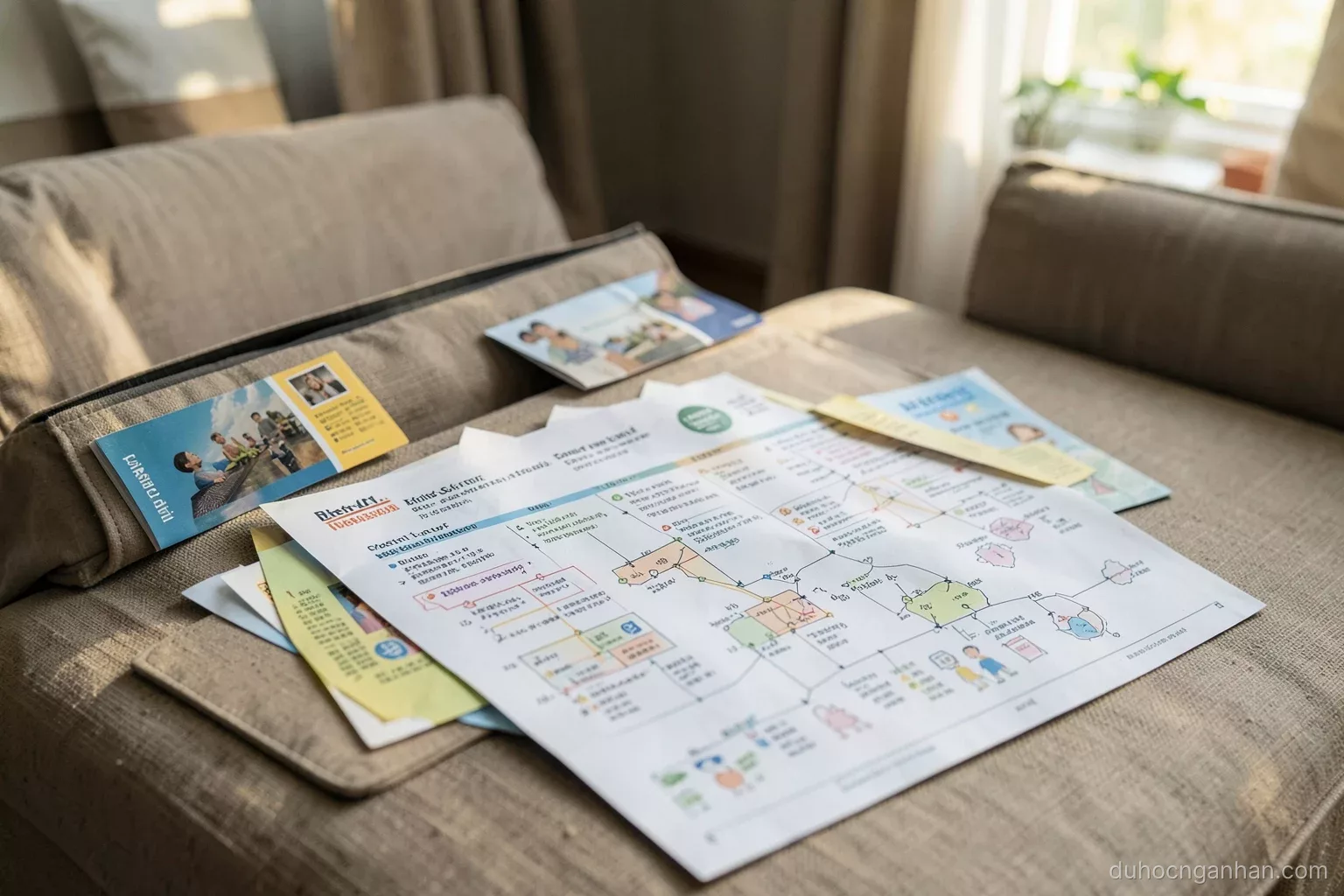
Working remotely while your child takes a short course abroad is how many parents accompany their child without taking long leave, and it works if three things are arranged in advance: accommodation with a quiet workspace and a stable connection with a back-up, meetings scheduled around school runs, and a back-up person for when urgent work clashes with a time your child needs you. Without any one of the three, the accompanying parent will feel they are doing both roles badly.
The easy part is that your child's lesson times usually coincide with office hours, so the block of time in the middle of the day can be devoted almost entirely to work. The hard parts are the joins: the morning drop-off, the afternoon pick-up, days when your child is ill and has to stay home, and meetings that run over. This article goes through each part, with a sample weekly schedule and a list of things to do before leaving Vietnam.
Time zones: when they help, and when they are a trap
For nearby destinations such as the Philippines, Malaysia or Singapore, the difference from Vietnam is only about one hour, so working hours almost coincide with colleagues at home. That is the easiest case: the accompanying parent works their usual office hours and just shifts meetings close to pick-up time a little.
For more distant destinations, the problem is quite different. If your child is studying in a country five or six or more hours from Vietnam, an afternoon meeting at home may fall in the early morning or late evening where your child is. The accompanying parent then works two shifts: an early shift before taking their child to school and a late shift after their child is asleep. This works for a week or two, but by the third week they are usually short of sleep and irritable, exactly when their child needs a calm adult.
Before choosing a destination, open your work calendar for the last week and place it on the time zone where your child will study. Regular meetings that fall at school-run times or your child's bedtime are meetings to renegotiate with your workplace before you go, not after you arrive.
Choosing accommodation for a remote worker
A real workspace, not the end of the bed. When asking about apartments or hotels, ask for photos of the desk and chair and whether there is a separate room or partition. Working on a bed for four weeks causes backache, and every video call will have your child walking around in the background.
A connection that has been tested. Ask the landlord or hotel about the real internet speed, whether there is a wired connection or only building-wide shared wifi, and whether the connection often drops when it rains. Read reviews from previous guests, especially those who say they worked remotely.
Close to the school rather than the centre. There are two school runs every day. A difference of fifteen minutes each way adds up to more than an hour a day, which is one meeting or one block of focused work less.
A café or co-working space nearby. When your child is ill and has to stay in bed, or when you need a quiet place for an important meeting, a second place within walking distance helps a great deal. Ask about opening hours and policies on staying for a long time.
Stable electricity and suitable sockets. Check the socket type, and bring an adapter and an extension lead. In places with frequent power cuts in the rainy season, a power bank big enough for a laptop can save a meeting.
A sample week for a parent who accompanies and works
The example below applies to a day course in a place close to Vietnam's time zone. What is worth learning is not the specific times but how the blocks of work are divided: focused work in the middle of the day, lighter tasks close to pick-up time.
| Time slot | Monday to Thursday | Friday | Weekend |
|---|---|---|---|
| Early morning | Read emails, list the day's tasks | As on other days | Rest, breakfast with your child |
| After drop-off | A focused block of work, notifications off | A shorter focused block | Outings with your child |
| Midday | Meetings with colleagues at home | Weekly review meeting | Outings with your child |
| Afternoon before pick-up | Light tasks: replying to emails, editing documents | Wrap up the week, take on nothing new | Rest |
| Evening after your child is asleep | Only when really necessary, an hour at most | No work | No work |
The general principle: do not schedule important meetings within an hour before pick-up time, because if the meeting runs over or the school calls about your child, the accompanying parent will be caught between the two.
When work and your child need you at the same time
The situations below happen on almost every accompanied trip with remote work. Thinking of the answers before you go means you do not have to decide hastily under pressure:
- Your child is ill and has to miss a day or two of school. Tell your workplace in advance that there may be days when you can only work half a day; prepare quiet toys, books and films for your child to rest with near your workspace.
- The school calls in the middle of a meeting. Always keep the school's number set to ring on your phone, even in meetings. Colleagues will understand an urgent call better than the school being unable to reach a parent.
- Deadlines pile up on the weekend your child has an outing with the camp. This is a good time to concentrate work, as long as your child does not miss the outing because the parents are busy.
- The connection drops just before an important meeting. Have a local data SIM to create a hotspot from your phone, and know the nearest café with a stable connection.
- The accompanying parent falls ill. Have a back-up person to collect your child: another parent at the same school, someone you know in that city, or ask whether the school offers after-school care.
A small tip: put your work schedule on a shared calendar that the parent at home can also see. When the accompanying parent is stuck, the parent at home knows when to call your child instead.
Keeping the two roles apart
Your child sees their parent working every day, very close by, in a small room. For young children that can be hard to understand: mum is right here but is not playing with me. Tell your child clearly from the first day that the mornings and middle of the day are their parent's working hours, just as your child has lesson times, and the afternoon after pick-up is time for the two of you. A small signal such as headphones on or a closed door helps your child know when not to interrupt.
The reverse matters too: once you have collected your child, put the laptop away. Children talk about their school day in the first hour or so after class; if parents listen while typing, the child stops talking. Unanswered emails can wait until the evening or the next morning.
With older children, from twelve upwards, you can invite them to plan the week together: your child writes down lesson times, activities and outings they want; the parents write down meetings and times they need to concentrate. Looking at a shared calendar, your child understands why their parents are sometimes not free, and the parents can see the gaps that genuinely belong to their child. Children who are involved in planning usually cooperate far more than children who are simply told "mum and dad are busy".
Weekends are the part most easily eaten away. A family going for four weeks only has four weekends there, and every weekend lost to work is another time your child stays in watching a screen when they could have been out. If necessary, work an extra hour each weekday evening rather than lose a whole Saturday.
Talking to your workplace: what should be agreed in writing
Many accompanying parents simply ask their line manager verbally, "I'll be working remotely for the next few weeks", and then set off. That is fine when everything goes smoothly, but easily leads to misunderstandings when something urgent comes up: the manager thinks a four o'clock meeting is fine as usual, when that is pick-up time. A short email sent before departure, stating the period of remote work, the hours when you can definitely be reached, the hours when it is difficult, and who covers in an emergency, gives both sides the same expectations.
If your work has fixed peak periods such as month-end closing, product launches or reporting periods, schedule the trip to avoid them from the moment you choose your child's course. Choosing a course a week later or earlier is usually much easier than trying to handle a peak period in a rented apartment thousands of kilometres from your colleagues.
Finally, be honest with your workplace about productivity. The accompanying parent, especially in the first week, will find it hard to do the full workload they do in the office. Agreeing a slightly reduced load in the first and last weeks, when you are dealing with enrolment and arranging the return, is usually better received than letting work slip past deadlines without warning. That transparency also helps the accompanying parent feel less guilty towards both sides.
Things to do before leaving Vietnam
The list below should be completed at least two weeks before the flight, because some items need someone else's agreement or time to prepare:
- Agree with your workplace: fully or partly remote, the hours you can be reached, which meetings need moving.
- Check working conditions at the destination: whether working remotely for a company in Vietnam during a short stay is consistent with your visa or visa exemption; ask the destination's embassy if unsure.
- Protect work data: do not use public wifi for sensitive documents unless you have a VPN as required by your company.
- Prepare equipment: laptop, charger, socket adapter, headset with microphone, a back-up hard drive.
- Choose back-up people: a colleague to take urgent work when you cannot be reached, and an acquaintance or another parent to collect your child when you are stuck.
For many families, the first week in a new place should reduce the workload to the lowest level possible. Your child needs their parents most in the first week, and the accompanying parent also needs time to find the market, learn the routes and get used to the new rhythm.
Frequently asked questions
Should we choose a boarding course for our child so the parents can work more freely?
If your child is old enough and used to being away from home, a boarding course with the parents staying nearby gives the accompanying parent more time. But do not choose boarding just because of the parents' schedule; if your child is not ready, they will need their parents more and the work schedule will fall apart too.
Does working remotely abroad for a few weeks require a work permit?
Rules differ between countries and are changing, and many countries have specific visas for remote workers. Ask the destination's embassy or immigration authority directly, and ask your company's HR department, before you go.
Should I use a local SIM or international roaming?
For remote workers, a local data SIM or eSIM is usually more suitable because of the large data allowance for a back-up hotspot. Keep your Vietnamese SIM in a second phone, or turn on roaming for messages only if you need to receive verification codes for banking and work.
What if my young child has to stay home when the school closes for a local holiday?
Many countries have their own public holidays when schools close, which do not coincide with Vietnam's calendar. Look at the school calendar as soon as you register, mark those days and move important work, or see whether the school has alternative activities for international students on holidays.
Is it easier if both parents work remotely?
It is easier to share school runs and looking after a sick child, but you need workspace for two people and a connection that can handle two video calls at once. Many families split shifts: one person has meetings in the morning, the other in the afternoon, so there is always someone free when the school calls.
Should we tell our child's teacher that the parents are working remotely?
Tell the person in charge of students which hours parents find it hard to answer the phone and give a back-up number. There is no need to explain your work; the school just needs to know whom to contact and how when something is urgent.