When the whole family travels while your child takes a short course abroad, there are four common arrangements: your child boards at the camp while the parents stay somewhere nearby; your child attends as a day student and comes home to the family in the evening; everyone in the family has their own classes; or the family is mainly on holiday and your child has a few lessons a day. The four differ in how many hours a day your child is apart from their parents, who looks after your child outside lessons, and what the family has to organise itself.
No arrangement is better for every family. A twelve-year-old who is used to sleeping away from home may lose out if the parents are too close; an eight-year-old going abroad for the first time may need exactly that closeness. This article goes through each arrangement, who it suits, what the family has to take on itself, and a set of questions for the whole family to sit down with and decide before looking at any programme.
The four arrangements side by side
The table below compares the four models on the points that decide your child's real experience, not on the names used in programme brochures. One programme may allow several arrangements, so read the table as four options the family sets for itself.
| Arrangement | How long your child is apart from parents each day | Who looks after your child outside lessons | What the family organises itself |
|---|---|---|---|
| Your child boards at camp, parents stay nearby | Almost all day and night, meeting according to the visiting schedule | Camp staff, dormitory managers | Accommodation, transport and the parents' own schedule |
| Your child is a day student and comes home in the evening | About six to nine hours during the day | The parents | School runs, dinner, weekends, accommodation |
| Everyone has classes | According to each person's class times | The parents, outside class times | Choosing classes for the adults, arranging a shared schedule |
| Mainly a holiday, your child has a few lessons | Two to four hours a day | The parents | Almost everything except lesson time |
The first and last rows are the two ends of a scale: at one end your child is almost completely independent; at the other, your child still lives within the family's rhythm. Most families going for the first time choose one of the two middle rows, then adjust on the next trip.
Your child boards at camp, parents stay nearby: when it suits
This keeps your child's boarding experience intact: your child sleeps in the dormitory, eats with friends and follows the camp's rules, while the parents rent accommodation in the same city or a few dozen minutes' drive away. Many parents choose this for the first trip because they want to be able to get there quickly if their child is ill or something happens, while still letting their child live with friends.
This suits children from about eleven or twelve upwards who have already slept away from home for a few nights, and families with the discipline to keep their distance. The biggest challenge lies not with the child but with the parents: knowing your child is only twenty minutes away, it is very hard to resist visiting every evening, calling at every break or taking your child out to eat every weekend. Then your child has two lives on top of each other and does not fully live either.
Before choosing, ask the camp whether parents staying nearby may visit, at what times, whether notice is needed, and whether children can be taken out overnight. Many camps have strict rules, and families should see those rules as an ally rather than an obstacle. This section has a separate article on visiting your child when parents stay near the camp.
Your child is a day student and comes home to the family in the evening
In this model, your child follows the school's lessons and activities from morning to afternoon, sometimes until after dinner, then comes back to stay with the parents in an apartment or hotel near the school. This is a familiar option for children from about six to ten, and for families whose children have never spent a night away from home.
The clearest advantage is that your child's sleep and meals keep their familiar pattern, and parents notice straight away when their child is tired or sad. In return, the family takes on the work that boarding staff do at a residential camp: taking your child to and from school on time every day, making dinner and breakfast, and finding things to do in the evenings and at both weekend days. Over four weeks, that is nearly twenty evenings and eight weekend days to fill so that your child still rests enough without sitting in front of a screen all day.
One point often overlooked: day students usually miss out on the camp's evening activities, which is when children make the most friends and speak English most naturally. If the school has evening activities open to day students, consider letting your child take part a few times a week instead of collecting them early every day.
Everyone has classes, or it is mainly a holiday
Everyone has classes. The parents sign up for an adult class at the same school or elsewhere in the city, your child attends their own class, and the family meets up in the afternoon. This suits families who want to share the experience of studying abroad, and parents who themselves need to improve a foreign language. What to avoid is turning the shared afternoon into time for parents to check their child's work.
Mainly a holiday, your child has a few lessons. The family chooses a resort with short classes for children, or books a few private lessons each morning, and spends the rest of the time sightseeing. This is the gentlest way for your child to get used to using English abroad, but it should be called what it is, a holiday with some lessons added, without expecting the progress of a full-day course.
Combining arrangements. Many families spend the first week with their child as a day student to get used to the school, then move their child into boarding from the second week once they have friends and more confidence. This combination only works if the school allows a change of arrangement midway, so ask at registration.
One parent goes, one stays at home. In practice, in many families "the whole family going" means one parent accompanies the child while the other stays at home working and sometimes flies out at the end of the course. Agreeing roles in advance means the parent at home does not feel left out, and the accompanying parent does not have to carry every decision alone.
What the family has to take on when going along
When your child travels with a group or boards, the organiser handles most of the logistics. When the family goes along, the following parts pass to the parents, and should be listed before deciding:
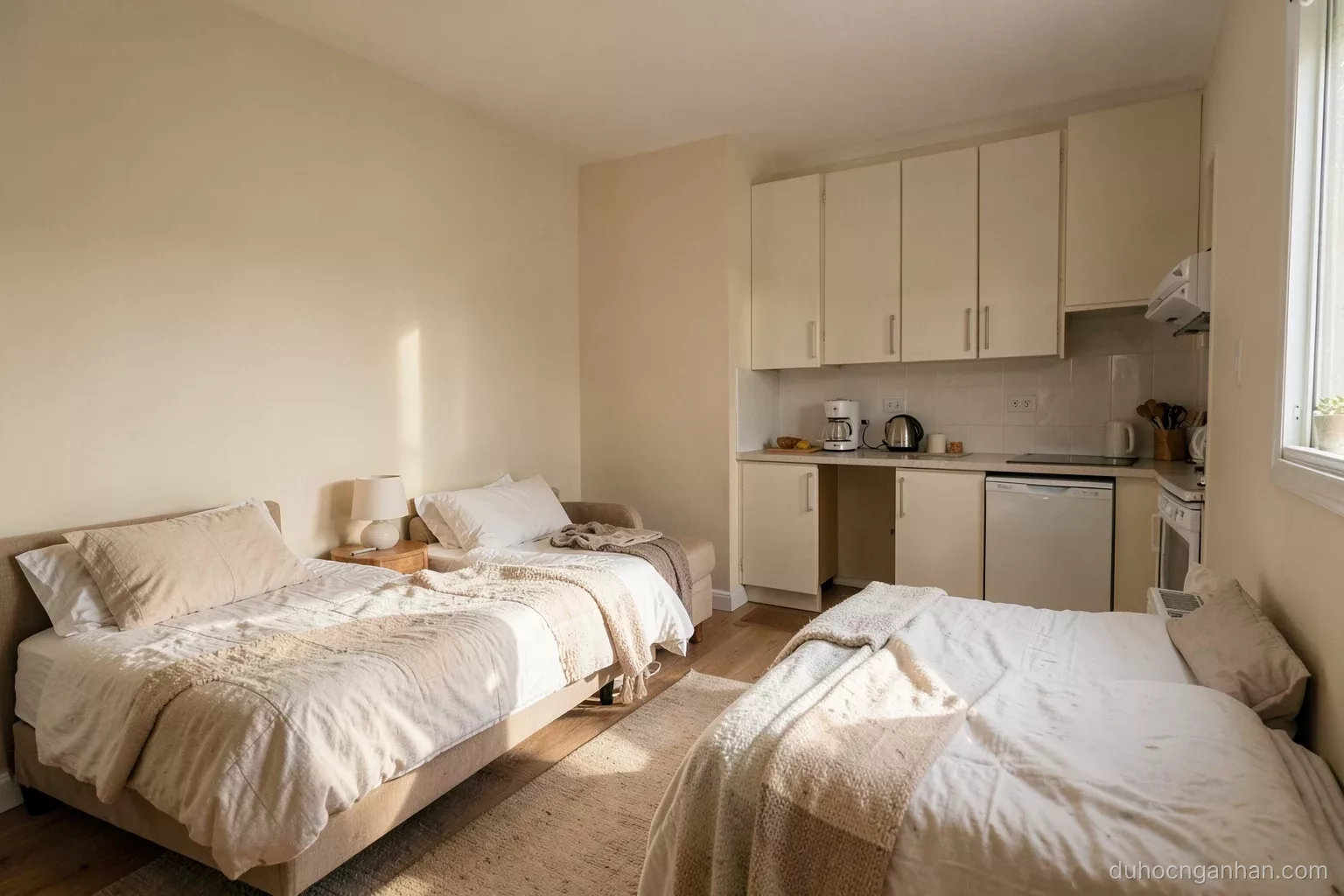
- Accommodation for the whole family: an apartment, a hotel or a family room on the school campus, with laundry and cooking facilities and the distance to class.
- Daily transport: school transport, rush hours, the rainy season, and who collects your child if the accompanying parent is ill.
- Insurance for each person: the school's insurance usually only covers registered students, not parents or younger siblings who come along.
- Meals and routines: who cooks, where you eat, and how to keep your child's bedtime while the family is somewhere new.
- The adults' schedule: what the accompanying parent does during the six or seven hours a day their child is in class, and whether they work remotely.
- Documents for the whole family: passports valid for long enough, entry conditions for each person, documents for a child travelling with one parent; check again with the immigration authority and the destination's embassy before the flight.
An advisory organisation can help with the study programme and part of the accommodation, but ask clearly which parts it handles and which the family handles, and write them down as a list so nobody assumes the other has done it.
Five questions the family should answer before choosing
Sit down together, including with your child if they are old enough, and answer in this order. The answers usually point to the arrangement that fits best.
- Whose trip is this? If the main goal is your child's experience of independence, the parents need to step further back. If it is a shared holiday with some study added, the family staying close to the child makes sense.
- How long has your child been away from home overnight? Never, a few nights, or a week at a camp in Vietnam. The answer almost decides between day attendance and boarding.
- What will the accompanying parent do all day? Without a clear answer, the risk of parents hovering and interfering in their child's day is very high.
- How much of the logistics can the family take on? School runs, cooking, weekends. Over four weeks, this is a real body of work.
- How will the next trip be different? Thinking one step ahead helps you choose today's arrangement as a step on a ladder, for example day attendance with parents this year and boarding with a group next year.
If after the five questions you are still torn between two arrangements, choose the one that gives your child a little more independence but with a clear fallback, for example boarding with the parents staying nearby in the first week.
Setting the right expectations for a family trip
A trip with the family along is usually smoother for young children, but also involves less "friction": your child has to cope alone less, ask strangers less, and always has parents to go back to when things are hard. That is not a weakness, just a different kind of experience. The family should measure success by real things: your child has a few new friends, dares to order food and ask the way, can describe a day in class in a few sentences of English, and wants to go back.
What to avoid is turning the trip into a project whose value the parents must prove, then watching their child hour by hour to see whether it has been worth it. Children sense very clearly when they are being assessed, and will learn less, not more.
The Global Gate Pass advisory team put this section together so families can see all the ways of going along with their child. Families who want to ask about programmes that accept day students or have accommodation for parents in upcoming sessions can request a consultation on the site.
Frequently asked questions
Do parents staying near a residential camp make it harder for their child to fit in?
They can, if parents see their child too often. Your child will save up their stories for their parents instead of telling friends, and will always have an escape route from the difficult first days. If you keep visits infrequent and agree them in advance with the camp and your child, being nearby mainly brings peace of mind without taking away from the experience.
At what age should a child board rather than attend as a day student?
There is no fixed age. Many camps accept boarders from about eight, but what decides it is whether your child is used to sleeping away from home and can manage personal care. Children under ten going abroad for the first time usually suit day attendance; from twelve upwards, many are ready to board.
Can a child switch from day attendance to boarding during the course?
Some schools allow it if there are dormitory places left and your child has completed the boarding registration, such as the health declaration and agreement to the rules. Ask before registering, because in the middle of the busy season the dormitory may be full and a switch may no longer be possible.
Does the school's insurance cover parents travelling with their child?
Usually not. Insurance bought or required by the school only applies to students registered on the course. Parents and children not attending need their own travel insurance; read carefully the sections on medical costs, evacuation and one person having to return home early.
What documents should we watch out for if only one parent takes the child?
Some countries have specific requirements for minors travelling with only one parent, such as a consent letter from the other parent. The rules vary by country and over time, so check directly with the destination's embassy and the immigration authority before booking tickets.
Does going as a family make my child speak more Vietnamese and learn less?
Outside class, yes, because your child speaks Vietnamese at home. In class, the effect is much smaller than having many classmates of the same nationality. You can make up for it by letting your child join the school's evening activities a few times a week and letting them order food and ask the way when the family goes out.