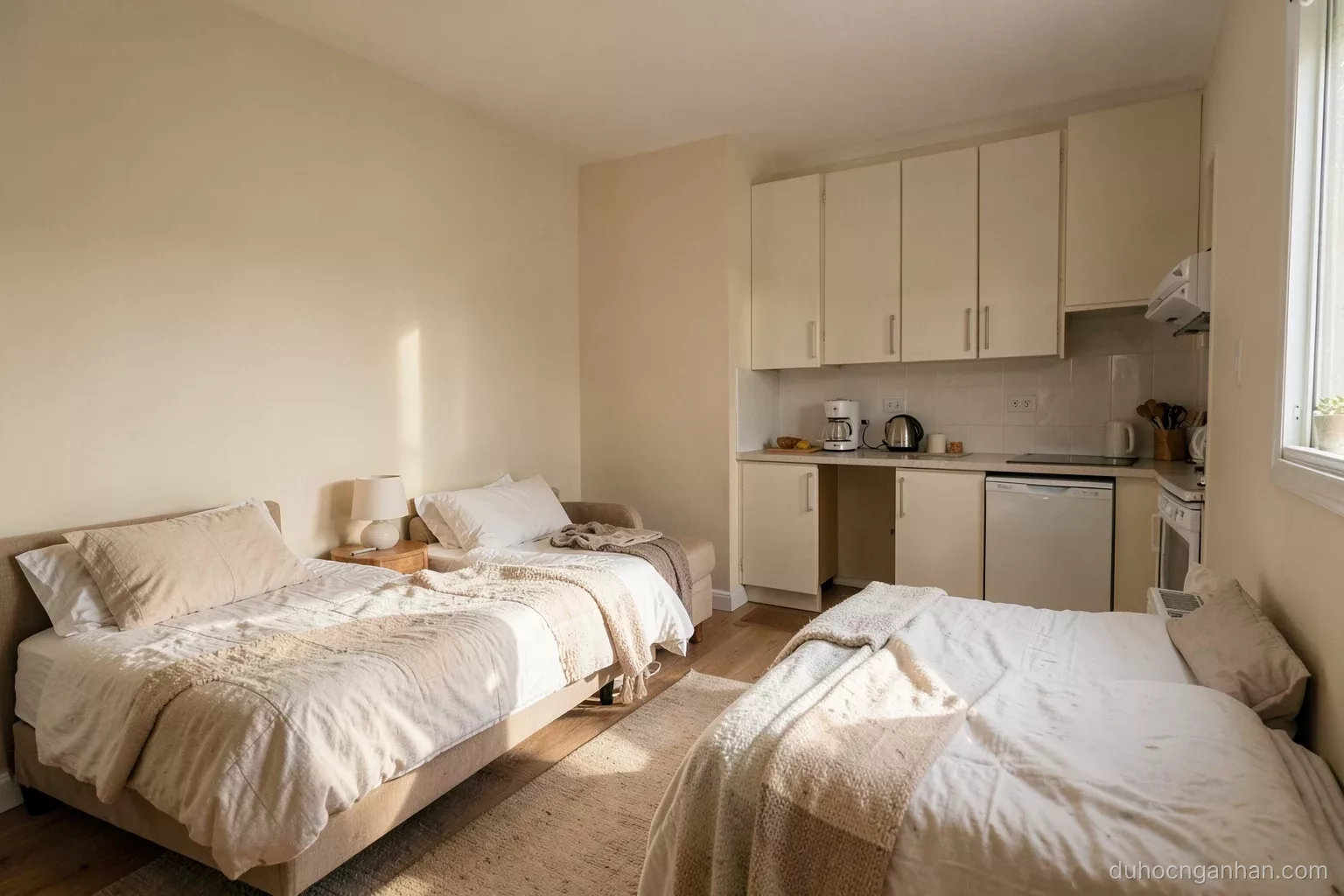
When the whole family goes along while your child takes a short course, there are four common types of accommodation: a family or parents' room on the school campus, a serviced apartment near the school, a hotel, and a private home rented by the month. The best choice is usually not the nicest place but the one closest to the school among those with a small kitchen, a washing machine and clear security, because four weeks in one place is very different from a four-day holiday.
Choosing accommodation is a decision that affects almost everything else about the trip: how long it takes your child to get to class, how the family eats, whether the accompanying adult has somewhere to work, and who looks after your child when they are ill. This article compares the four types of accommodation, the points to check before booking, the questions to ask landlords or hotels, and the common traps when renting from afar.
The four types of accommodation side by side
The table compares them on the points that decide daily life over several weeks, not on star ratings or advertising photos.
| Type of accommodation | Strengths | What to check | Suits |
|---|---|---|---|
| Family room on the school campus | No travelling, the school's security, close to your child when needed | Is there enough room for the whole family, is there a kitchen, what are the rules on entry times | Families with young children, first time abroad |
| Serviced apartment near the school | Kitchen, washing machine, separate rooms, regular cleaning | The real distance to the school, the rental contract, the deposit | Families staying two weeks or more |
| Hotel | Easy to book, full services, flexible arrival and departure dates | No kitchen, cramped for four weeks, laundry costs | Trips of one or two weeks, or the first few nights |
| Private home rented by the month | Spacious, with a kitchen, close to local life | Security of the area, contact with the landlord, the real condition of the house | Families who already know the place or have a personal recommendation |
Many families combine them: a few nights in a hotel at the start to have time to look at places in person, then a move to a serviced apartment they have checked out. This reduces the risk of renting somewhere that does not match the photos, but means moving your luggage one more time.
Family rooms on the school campus
Some boarding schools and language schools have rooms for parents or whole families, usually in a separate building or a separate area of the dormitory. The biggest advantage is time: your child walks a few minutes to class, the accompanying adult does not have to worry about school runs, and when your child is ill they are just across the grounds. Security is the school's security, with guards and controlled entry.
What to check is what the room really has. A parents' room is often a dormitory room that has been rearranged, with no kitchen, single beds pushed together and shared bathrooms on each floor. Families with a baby or older relatives coming along need to ask carefully about private bathrooms, air conditioning and space for a cot or extra bed. Also ask about the entry rules: many schools close the gates in the evening, and parents returning late from an outing of their own may not be able to get in.
A delicate point: staying on campus means your child and their friends see the parents every day. For older children this can be embarrassing; younger children may run to their parents' room at every break instead of playing with friends. Agree with your child in advance when they can come and see you.
Private rentals and hotels: when to choose them
Hotels suit short trips of one or two weeks best, or the first few nights while the family is still getting to know the area. The advantages are easy booking, a reception desk open day and night, daily room cleaning and fairly flexible arrival and departure dates. The disadvantages become clear from the second week: the room is cramped for the whole family, you cannot cook, eating out at every meal is both costly and makes it hard to manage children's portions, and laundry is charged by the item. If you must stay in a hotel for a long time, choose a room with a kitchenette or connecting rooms so there is space for your child to do homework and nap.
Private homes rented by the month are usually spacious and feel like home, but they are the option with the most unknowns when booking from afar. The landlord may not reply quickly when the water heater breaks, the neighbourhood may be deserted in the evening, and the family has to deal with everything from rubbish to utilities. This option works best when someone you know in that city recommends it, or when the family has been there before and knows which areas suit.
Whichever you choose, arrive at least a day or two before your child's course starts. That buffer gives the family time to check in, go shopping, try the route to school at the time of day lessons start, and let your child sleep a night to recover from the flight before the first day of class.
Serviced apartments: the points that make a difference after four weeks
Distance measured in minutes at rush hour. One kilometre can mean five minutes or thirty depending on the city and the time of day. Ask the landlord or the school how long the journey takes at seven in the morning and four in the afternoon, and whether there is a safe walking route for children.
A small kitchen that is good enough. At least an electric hob, pots, a frying pan, a fridge, a rice cooker or microwave. Ask for a specific list of kitchen equipment, because "has a kitchen" in a description sometimes just means a kettle.
A washing machine in the apartment or the building. Children studying in hot, humid places change their clothes twice a day. Without a washing machine, the family will have to take laundry out two or three times a week.
Cleaning and towel changes. Serviced apartments are usually cleaned once or twice a week. Ask for the specific schedule so it does not clash with the accompanying adult's meetings or your child staying home ill.
The contract and the deposit. Read the terms on cancellation, deposit refunds, and whether utilities are charged separately or included. Keep photos of the apartment's condition on arrival to avoid disputes when you leave.
Security and safety when staying with children
Accommodation for families with children needs an extra layer of checks, beyond what adults on business trips usually look for:
- The building entrance: is there a security guard or key-card lock, can strangers walk straight into the corridors.
- Windows and balconies: are there safety locks or guards, especially in high-floor apartments with children under ten.
- The building's pool: is there a lifeguard, what are the opening hours, and is there a rule that children must be accompanied by an adult. This is the most underestimated risk.
- Emergency exits: walk the route once with your child on the first day, showing them the fire escape stairs and the assembly point.
- The surrounding area: does the route from the accommodation to school have pavements and street lighting, and is there any stretch where you have to cross a major road without traffic lights.
- Emergency contacts: the reception or landlord's number, the local emergency number, and the address of the accommodation written in the local language to show drivers, saved on the phones of both parents and the child.
The site's safety and health section has a separate article on incidents while your child is at camp. The list above only covers what relates directly to where the family is staying.
Booking accommodation from afar without surprises
Most families have to book accommodation before arriving, based only on photos and messages. The steps below reduce that risk:
- Ask the school first. Schools often have a list of places where previous students' families stayed, or arrangements with a few apartment buildings nearby.
- Read reviews from families with children. Business travellers and families notice different things; look for reviews that mention children, noise, kitchens and laundry.
- Ask for a video call to see the apartment. Serious landlords usually agree. Ask them to film the entrance, corridor, kitchen and bathroom, not just the living room.
- Book short first, extend later. If possible, book the first week with an option to extend, so you can still change if the accommodation is not as described.
- Keep every exchange in writing. Anything the landlord promises by phone should be confirmed by message or email.
For trips on a programme run by an advisory organisation, ask clearly whether the organisation helps parents find accommodation and, if so, how far that help goes: recommendations, booking on your behalf, or just providing a list.
Living for four weeks in a rented room
However nice the accommodation, after a few weeks it starts to feel cramped, especially when it rains for days on end and the whole family has to stay indoors. Many families find it more comfortable to divide the space from the start: a work corner for the adults, a corner for your child with books and toys, a place by the door for shoes and wet things. A little order helps everyone bump into each other less in a small apartment.
Your child's sleep needs a minimum of private space, even when the whole family is in one room. A curtain across the room, a desk lamp turned the other way, or simply agreeing that after your child's bedtime the adults move to the living room or balcony, helps your child sleep enough to have the energy for class the next morning. Adults staying up late on their phones next to their child's bed is one of the most common reasons children get more tired week by week.
Another habit worth keeping is going out every day, even if only for a while: a walk around the area, a trip to the nearest park, shopping at the market with your child. Children who stay in the room all afternoon after class easily get irritable and ask for screens; half an hour outside is enough to change their mood.
And remember that accommodation is just accommodation. What the family remembers longest is usually the afternoon walks, unusual food at the night market and a cheerful neighbour, more than a room with a nice view. The money and effort put into accommodation should stop at safe enough, close enough and convenient enough; the rest is for the experience.
Frequently asked questions
How far in advance should we book accommodation?
For summer and long holidays, accommodation near the school goes quickly because many students' families are looking at the same time. Book once your child's course dates are certain, usually several months ahead. If you are not sure yet, choose places that allow free cancellation for a period.
Is it better to stay near the school or near the city centre?
For courses of two weeks or more, near the school is almost always better, because school runs happen every day while trips to the centre only happen a few times a week. The exception is when the school is somewhere very quiet, without markets or medical services nearby.
Should we share an apartment with another family whose child is on the same course?
You can, if the two families already know each other and agree in advance on sharing costs, routines, cooking and laundry. Sharing gives you a back-up for collecting children, but small frictions easily arise after a few weeks. This section has a separate article on two families travelling together.
Can a younger sibling stay in a parents' room in the dormitory?
It depends on the school. Many schools only accept adults accompanying registered students, not young children who are not studying, for safety and insurance reasons. Ask clearly before booking, including whether the younger sibling may enter the students' common areas.
How can I tell whether an apartment is safe for children from photos alone?
Ask about each point specifically: window locks, balcony guards, whether the pool has a lifeguard, whether the entrance has security. Ask for a video call so the landlord can film those areas. On the first day, check everything again before leaving your child alone in the room even for a few minutes.
Should we choose accommodation with a pool for our child to use in the afternoons?
A pool is a great joy for children after class, but also a real drowning risk. Only let your child into the water when an adult who can swim is right beside them, even if the pool has a lifeguard, and ask when the lifeguard is on duty. Children under ten should not go to the pool area alone.