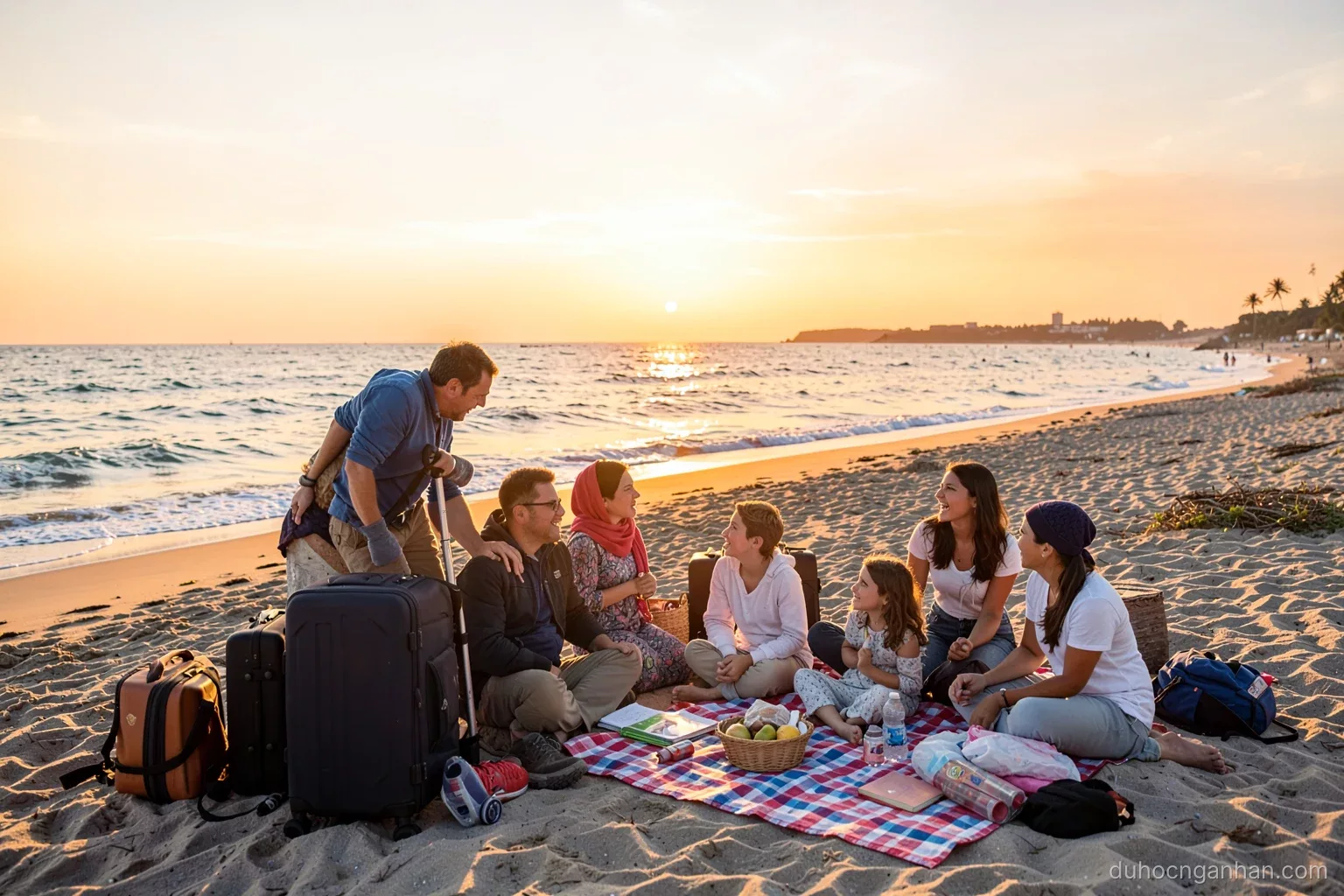
There are three ways to combine a family holiday with your child's short course: travelling for a few days before the course starts, travelling after it ends, or fitting short trips into weekends during the course. For most families, travelling after the course is the smoothest option, because your child starts class with their health and attention intact, then gets a holiday as a reward once the work is done. Travelling before the course suits families who need a few days for their child to adjust to the climate and time zone; weekend trips during the course should be kept light.
The most common mistake is trying to cram too much into one trip: wanting your child to learn a lot, wanting the whole family to see many places, and wanting the adults to rest, all at once. The result is a tired child in class and tired adults on returning home. This article goes through the pros and cons of each approach, a sample schedule for a four-week trip, the signs that the schedule is too full, and how to choose outings that do not disrupt your child's study rhythm.
The three approaches side by side
Each approach has its uses. The table helps the family see the cost of each one before booking tickets:
| Approach | Strengths | The price to pay | Suits |
|---|---|---|---|
| Holiday before the course | Your child gets used to the climate and food, and jet lag has passed by the time class starts | Your child is easily tired and still in holiday mode when the first day of class comes | Destinations several time zones away, children sensitive to weather |
| Holiday after the course | Your child studies with full energy, and the holiday is a reward once the work is done | The accompanying adult has been there a long time and may be tired before the holiday begins | Most families, especially on a first trip |
| Short trips at weekends | The family explores many places without extra leave | Your child loses weekend rest and may miss the camp's group outings | Older children, day courses, short day trips |
| No combination, study only | Simple, your child stays focused, costs are contained | The family travels far but has few shared experiences | Children boarding with a group, parents not travelling |
You can combine both ends: two days before the course to settle into the accommodation and a week after the course for a holiday. What to avoid is combining all three, because then there is almost no day when the whole family really rests.
Why a holiday after the course is usually smoother
A short course is designed for your child to concentrate their effort on study for a few weeks. The first week is the hardest: a new class, new friends, new teachers, new accents, sometimes new eating and sleeping patterns too. A child who has just spent five days sightseeing non-stop, sleeping late, walking a lot and eating irregularly will go into that week with much less energy. Many teachers can spot straight away the children who arrive after a long holiday: yawning a lot, easily tearful, losing concentration after lunch.
Conversely, when the holiday comes after the course, it becomes something for your child to look forward to. Your child knows that after four weeks of study there will be a week at the beach or a week visiting another city, and the motivation to finish the course is clearer too. In terms of language, a holiday after the course has another small benefit: your child puts the English they have just learned to use straight away when asking the way, ordering food and buying tickets, and clearly feels their progress.
What needs considering is the accompanying adult's energy. A parent who has done four weeks of school runs is usually tired when the holiday begins. If possible, the other parent flies out at the end of the course to go on holiday together, both sharing the work and turning the last week into a family reunion.
When to travel before the course
Destinations with a large time difference. If your child is studying somewhere five or more hours from Vietnam, in the first few days they will be sleepy at midday and awake in the middle of the night. Arriving three or four days early, with gentle activities and morning sunlight, helps your child reset their body clock before class.
A climate very different from home. A child from southern Vietnam going somewhere cold, or from a dry place to somewhere hot and humid, needs a few days for the body to adjust. These days should be for light outings near the accommodation, not mountain climbing or walking all day.
Children who get anxious in unfamiliar places. Some children need time to feel that a new place is safe before they have to meet strangers. A few days walking around the area, passing by the school gate, trying the route to class and tasting local food help your child feel less tense when the first day of school comes.
Keep to the rule: the last two days before the course are rest days. However long you travel before the course, the two days right before the start should be for sleeping enough, packing the school bag, trying the route and getting used to the accommodation. That is when your child shifts from holiday mode to school mode.
A sample schedule for four weeks of study and one week of holiday
The example below is for a child on a day course, with one accompanying parent and the other parent coming out at the end of the course. Families can stretch or shrink it according to their actual leave:
- Two days before the course: fly out, check in, go shopping, try the route to school, go to bed early.
- The first week of study: no long trips. At the weekend just go to a nearby park or beach, so your child can rest after the stressful first week.
- The second and third weeks of study: one day trip each weekend, back before dinner. If the camp has a group outing, let your child go with friends as a priority.
- The fourth week of study: keep it light again. Your child has the closing session, and sometimes a test or an end-of-course performance; the other parent flies out at the weekend.
- The holiday week: the whole family travels, ideally to one or two places rather than five, with at least two days without a schedule.
The key point of this schedule is that the first and last weeks of the course are kept quiet. Those are the two weeks when your child needs the most energy, one to adjust and one to finish.
Signs that the schedule is too full
The signs below usually appear from the second week. When you see two or three at once, it is time to cut a trip:
- Your child falls asleep in the car on every outing, or finds it hard to get up on Monday morning.
- Your child is much more irritable with siblings and parents than usual, and cries over small things.
- The teacher messages to say your child is tired or losing concentration at the start of the week.
- Your child says they do not want to go out any more and just want to stay home.
- The accompanying adult finds themselves planning the weekend rather than resting at the weekend.
- The family takes lots of photos but nobody remembers what they did in each place.
A day with no plans, just eating, sleeping, reading and going to a nearby park, often gives children more than a long trip. Children need time doing nothing to sort out what they have experienced.
Choosing outings that do not disrupt your child's study rhythm
Outings during the weeks of study should be short and close, and should not require your child to get up early or come back late. A beach an hour's drive away, a nature reserve, a weekend market, a small museum with activities for children: places like these show your child the country where they are studying without taking away their energy for Monday.
Longer trips, involving domestic flights, overnight stays or many places in one day, should be saved for the holiday week after the course. The rainy season is also a factor: in many tropical countries, afternoon rain can last a long time and roads become difficult, so choose places with an indoor option in case of bad weather.
A good approach is to let your child help choose outings based on what they hear in class. A classmate talks about a beach, the teacher recommends a dish or a market: when the family goes to exactly that place, your child has something to tell friends on Monday, and that is one of the most natural ways for your child to use English outside class.
For group outings organised by the camp at weekends, consider letting your child go with friends rather than going separately with the family. Group outings are when children become closest, and a child who misses one to go out with their parents will miss part of the stories the whole class tells the following week.
The holiday week after the course: keeping it a real holiday
A small suggestion: choose a holiday destination in the same country or near where your child has just studied, rather than flying straight to another country. One flight fewer, one immigration process fewer, and your child can still use the English phrases, foods and manners they have just got used to at school. A trip on to another country is better saved for families used to long trips and older children.
The holiday week after the course easily turns into a race around the sights: having come so far, the family wants to make the most of it and see every famous place. But your child has just finished four weeks of study, the accompanying adult has just managed four weeks, and the parent who has just arrived has just taken a long flight. A real holiday week should have few places, days for sleeping in and long meals without hurrying.
It is also a good chance for the whole family to hear your child talk about the course, once they have a few days' distance from class and are no longer tired. Many parents find their child talks most not on the last day of the course, but a few days later, on an afternoon at the beach or on a train. Those stories are the gift of the trip.
If there is a rainy day during the holiday week, do not try to find somewhere else to go to fill the schedule. An afternoon with the family indoors playing cards, looking back at photos from the course, with your child pointing out each friend and naming the teachers, is often the afternoon your child remembers longest from the whole trip.
Finally, leave a buffer of a day or two after returning to Vietnam before your child goes back to school or other activities. Your child needs time to shift from the rhythm of the trip back to the rhythm of home, and the family also needs time to do the washing, unpack the suitcases, hand out gifts and tell the grandparents all about it.
Frequently asked questions
Should my child miss a day or two in the middle of the course so the family can travel further afield?
Not on a short course. Each day of study on a course of a few weeks is a much larger share than one day in a school year, and children who miss days in the middle often find it hard to get back into the rhythm of the class. Save the long trip for the holiday week after the course.
How many days of holiday before the course is about right?
For destinations close to Vietnam's time zone, two or three days is enough for your child to get used to the accommodation. For destinations several time zones away, four or five days helps your child adjust their sleep. However many days, keep the last two really light before the course starts.
If my child is boarding, should the family travel while they are studying?
Yes, that is exactly when the adults have time to themselves. But make sure the camp can contact the family at all times, and that the family can come back within a reasonable time if your child falls ill. Avoid going somewhere you will be out of contact for several days.
Should we book a tour in advance for the holiday week after the course?
Booking accommodation and the main transport in advance is enough. Leave the day-by-day schedule partly open, because after four weeks of study your child may be more tired than expected, or have their own wishes based on what they heard in class. A holiday with some space in it is usually more enjoyable than a tightly scheduled tour.
Will the holiday make my child forget what they have just learned?
Not noticeably over a few days, especially when your child uses English while travelling. Keeping language skills in the long term depends more on the months after returning home than on a week's holiday. Encouraging your child to order food, ask the way and buy tickets themselves during the holiday is a natural form of revision.
Should we choose the course location first or the holiday destination first?
Choose the course first. The course decides your child's main experience, while holiday destinations can be chosen around where your child studies. Choosing the other way round easily leads to a course that does not suit your child just because it is near where the family wants to holiday.