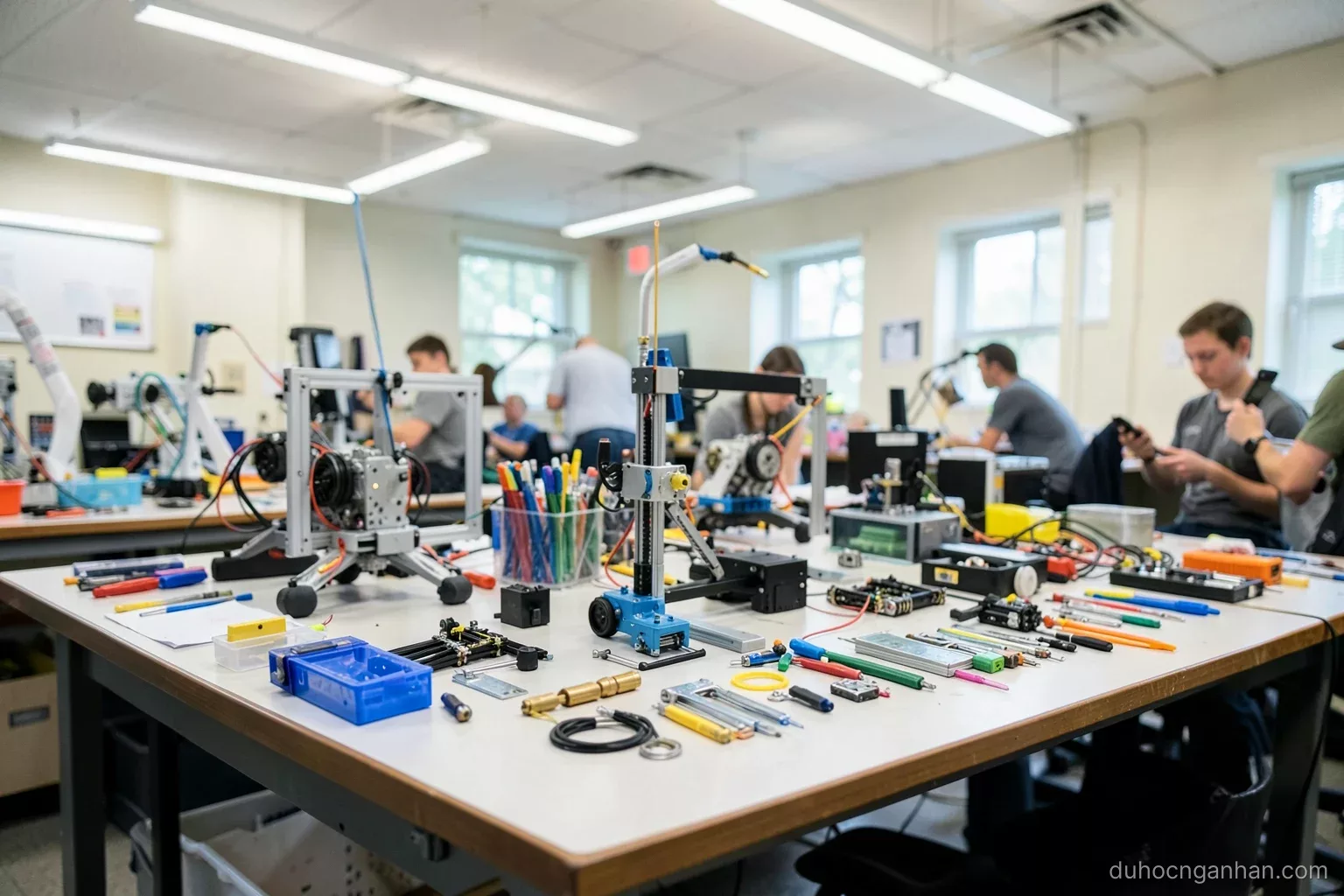
A STEM summer camp abroad is a short programme, usually one to four weeks, in which your child spends most of the time on hands-on projects in science, technology, engineering or maths: building and programming robots, writing simple games, designing and 3D-printing models, doing chemistry and biology experiments, or solving engineering problems in teams. English is the working language; your child learns the technical terms because they need them to finish the product.
STEM camps suit children best who already have a real interest: they often take toys apart to see how they work, teach themselves block coding, love asking why. For children without that interest, a STEM camp can still be a good experience if the right level is chosen. This article explains the common types of STEM camp, how to read a curriculum to know what your child will really do, the English level needed and the signs that the word "STEM" is just a label.
Common types of STEM summer camp
The word STEM covers a very wide range. When comparing programmes, sort them into one of the types below so you compare like with like.
| Type of camp | What your child does during the day | End-of-course product | Usually suits ages |
|---|---|---|---|
| Robotics and electronics | Building frames, connecting sensors, programming robots to move, obstacle races | A robot that completes a task | 9–16 |
| Coding, games, apps | Writing code through exercises, then a group project | A small game or app that runs | 10–17 |
| Experimental science | Chemistry, biology and physics experiments in a supervised laboratory | A report or presentation of the results | 11–17 |
| Engineering and design | Drawing, building models, 3D printing, testing strength, building bridges, water rockets | A model that passes its test | 9–15 |
| Maths and thinking | Puzzles, applied maths, data modelling | A presentation of the solution | 11–17 |
| STEM combined with nature | Ecological observation, water testing, night-time astronomy | An observation journal | 9–14 |
The ages in the table are typical, not rules; each camp sets its own thresholds. Camps for young children usually use kits with step-by-step instructions, while camps for older pupils let them define the problem themselves and live with their own failures.
What a week at a STEM camp looks like
A serious STEM camp usually builds the week around the familiar engineering loop: understand the problem, design, build, test, fix. On the first day your child is introduced to the week's challenge and the tools; the two or three middle days are for building and breaking things; on the last day each group presents its product to the other groups. The "breaking" part is the most important: if everything works the first time, the challenge was too easy.
During the day, the specialist block usually takes one long session or two short ones of two to three hours each, with breaks, lunch and physical activity in between. Many camps put pupils into groups of three to four, each with a role — builder, programmer, note-taker, presenter — and rotate roles after each project so that everyone touches every part.
In the evenings and at weekends, STEM camps usually have the same kind of activities as other camps: games, excursions, sometimes a visit to a science museum or a nearby university laboratory. Read the weekly schedule to know whether those trips are part of the programme or just optional activities.
Reading a STEM camp curriculum: five questions that need answers
How many hands-on hours are there each week? Count the hours your child does things with their own hands, not hours of listening to explanations or watching demonstrations. A STEM camp with substance gives most of its specialist block to hands-on work.
What tools will your child use? Which kit, which programming language (block coding for young children, text-based languages for older pupils), and whether pupils use 3D printers or cutting machines themselves. The names of the tools tell you the level of the course.
What is the ratio of machines and equipment to pupils? When four children share one robot kit, three of them sit and watch. Ask directly how many people are in each group and whether each person has their own computer.
Who teaches? Instructors with technical expertise, or camp staff with brief training? Many camps use engineering students as teaching assistants, which is fine as long as there is a subject specialist behind the curriculum.
What does your child bring home? The product, the source code, photos of the process, or only a certificate? Camps that let pupils take their source code home help your child continue at home, a sign that the camp is thinking about long-term learning.
The English level your child needs for a STEM camp
STEM has the advantage that much of it is visual: if a gear does not turn, everyone can see it. So children with elementary English can still take part in camps using kits with picture instructions. The difficulty comes when they have to discuss with their group why the robot turned the wrong way, or explain to the class why they chose a design. Those are the moments when your child needs complete sentences, not just single words.
Camps with chemistry and biology laboratories demand a higher level of English because safety is involved: your child must understand warnings about chemicals, heat and sharp tools. A serious camp will check this in advance, or have a rule that pupils below a certain level only do experiments together with a teaching assistant.
A month before leaving, parents can help their child get familiar with the vocabulary of the exact area they will study: the names of tools, verbs for actions (connect, twist, measure, cut, test run), and how to ask "why isn't this working?". Learning this vocabulary through English instructional videos with pictures is faster than learning word lists. Your child does not need to be good at everything, just good enough not to be left out of the group's discussion.
Signs that a "STEM" camp is just a label
Because STEM is a keyword that sells easily, quite a few programmes stick it onto an ordinary camp. The following signs are worth asking about again before enrolling:
- The weekly schedule has only one or two short "STEM activity" sessions; the rest is language lessons and sightseeing.
- The activities are watching demonstrations, visiting museums and listening to talks, with no part where your child makes something themselves.
- No specific tools, programming languages or equipment are named, only general phrases such as "exploring science" or "creative thinking".
- There is no end-of-course product, or the product is something made from a template, identical for the whole class.
- The same programme is offered to 8-year-olds and 16-year-olds alike, with no grouping by level.
- The teachers are not introduced, or are only referred to generally as "activity staff".
One or two of these signs do not necessarily mean a bad camp; it may be a language camp with gentle afternoons, suitable for young children going far away for the first time. The problem only arises when a family chooses a camp hoping their child will really study STEM and gets a different programme.
Safety in the camp's workshops and laboratories
STEM camps have risks that language camps do not: soldering irons, craft knives, small drills, hot glue guns, diluted chemicals, short-circuited lithium batteries. A properly run camp will have a safety briefing on the very first day, safety glasses and gloves in children's sizes, and clear rules on which tools pupils may use on their own and which only with an adult standing beside them. Laser cutters and large 3D printers are usually operated by staff, with pupils only submitting their designs.
Parents should ask the camp three things: in which language is the safety briefing given, and do they check afterwards that pupils have understood; who in the workshop area holds a first aid certificate; and how does the camp handle a child with a minor burn or a cut? A clear answer, with a procedure, shows the camp has thought ahead. An answer like "nothing has ever happened" is not enough.
At home, give your child one simple rule: if you don't understand a safety instruction, ask again, even if you have to ask three times, and never guess. Vietnamese children often hesitate to ask for fear of being a nuisance; in a workshop, asking again is encouraged.
Helping your child prepare for a STEM camp
Preparation does not mean learning the content in advance, but getting used to the way the camp works.
- Let your child try a small project at home. Put together a simple circuit kit, make a game with block coding, or build a bridge out of lolly sticks. The point is for your child to get used to the feeling of breaking something and then fixing it.
- Practise working in a group with strangers. A short summer class in Vietnam, where your child has to share tasks with new friends, is a good stepping stone.
- Get familiar with the vocabulary of the area they will study. Through English instructional videos with pictures, fifteen minutes a day for a few weeks.
- Talk about failure in advance. Tell your child that a robot not working is an everyday thing at camp, and that the clever one is the person who finds out why it doesn't work.
- Ask the camp for the packing list. Some coding camps require pupils to bring a laptop; in that case, install the software beforehand and bring a plug adapter.
After camp, keep the spark alive by having your child talk about their project, open up the source code again or find a science club near home. A STEM summer is most valuable when it opens up an interest that lasts all year.
STEM camps and parents' realistic expectations
A few weeks at a STEM camp will not turn your child into a programmer or an engineer. What the camp can do is let your child touch the way people in science and engineering really work: breaking a big problem into small parts, trying, failing, measuring, fixing and explaining it to others. Your child also sees pupils from other countries approach the same problem differently from them.
Parents should avoid asking "what prize did you win?" or comparing their child's product with a friend's. More useful questions are "which part was hardest?", "how did your group fix that bug?", "if you did it again, what would you change?". These questions help your child look back at how they think, which is what remains long after the robot has been taken apart.
If your family is considering a STEM camp abroad, the Du Học Ngắn Hạn advisers can send sample curricula, tool lists and grouping arrangements for the programmes currently taking registrations, so the family can read them against the five questions above.
Frequently asked questions
Can my child join a STEM camp if they cannot code yet?
Yes; most camps have groups for beginners, usually using drag-and-drop block coding or kits with instructions. When registering, be honest about your child's level so the camp places them in the right group; overstating their level will leave your child struggling and losing interest in the first week.
Are STEM camps suitable for girls?
Yes. Many camps actively balance genders in groups, and some have girls-only groups to help them feel bolder. What matters is whether your child is interested, not their gender. You can ask the camp for the gender balance of previous sessions if your child feels hesitant.
Does my child need to bring their own computer?
It depends on the camp. Robotics camps usually provide all the equipment; coding camps for older pupils sometimes require a laptop. If your child takes one, install the software according to the camp's instructions beforehand, label the laptop and charger, and buy insurance that covers electronics.
Are there competitions at STEM camps?
Some camps hold competitions between groups at the end of the week, such as robot obstacle races or bridge load tests. Competitions like these are for fun and to give a finishing point. Parents should encourage their child to focus on the process of making rather than the ranking.
How is a STEM camp abroad different from a STEM class in Vietnam?
The content may be similar; the differences are that your child works in English with friends from many countries, uses the workshops and laboratories of the host school, and studies continuously for many hours each day instead of one or two sessions a week. Intensity and environment are the main differences.
Which type of STEM camp should a young pupil choose?
For children of about 8–11, robotics camps using kits with instructions, engineering camps building models and science camps combined with nature usually suit better than text-based coding camps or chemistry laboratories. Young children need to see results quickly with their hands and eyes.