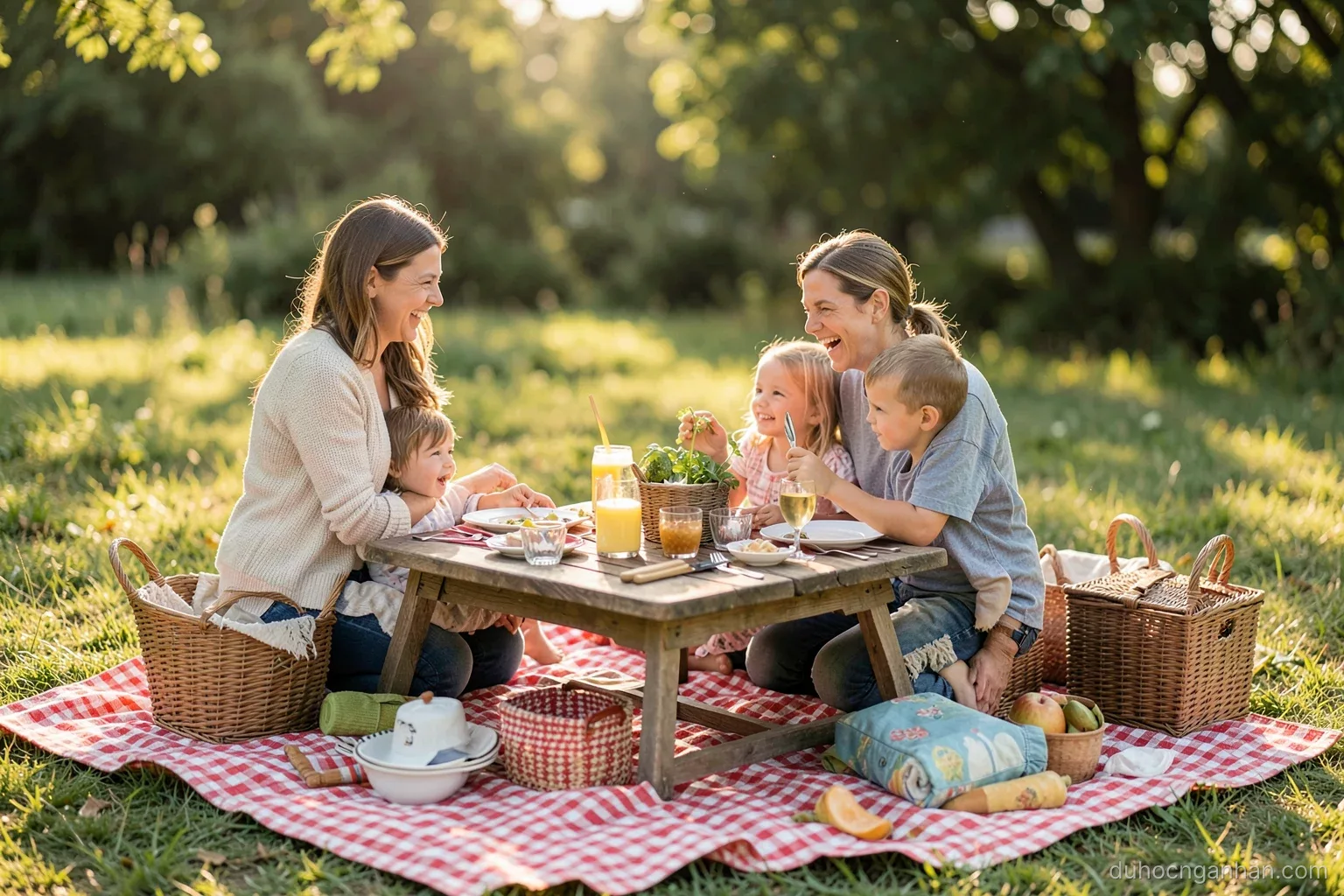
Two families sharing a short study trip for their children, staying close together and taking turns with school runs, can make things much lighter than one family going alone, provided both families agree clearly in advance on five things: accommodation, school runs and cooking, how spending is shared, common rules for the children, and how to handle it when the two families disagree mid-trip. Most shared trips that become tense do so not because the two families do not get on, but because things that seemed obvious were never said out loud.
This kind of shared trip usually starts with two families whose children are close friends, or two mothers who know each other from their children's class. This article goes through the real benefits of going together, the agreements to make before booking, whether to share accommodation or stay separately, the children studying together, and how to keep the peace when several weeks of living close together start to reveal small differences.
The real benefits of going together
Having a back-up. When one adult is ill, when one family has something urgent to deal with, or when one child has to miss school, there is always another adult to collect the children. For a parent accompanying a child alone, this is what is missing most.
Sharing the daily work. One family does the morning drop-off, the other the afternoon pick-up; one family cooks on Monday evening, the other on Tuesday. The accompanying adults have more time for work or for themselves.
Adults have company. After a few weeks in an unfamiliar place, accompanying adults also feel homesick and lonely. Having another adult in the same situation to talk to is real emotional support.
The children have a familiar friend. For young children, having a familiar friend in the first days reduces fear. But this is also a point to weigh up; see the section below on the children studying together.
The trip is psychologically lighter. The two families research together, ask the school together and share experience, so decisions rarely have to be made alone.
Five agreements to make before booking
Sit down together, both parents from each family if possible, and go through each point clearly. Write it down in a few lines of messages so nobody remembers it differently later:
- Accommodation: sharing one large apartment, two apartments next to each other, or two places close by. Who books, whose name it is in, how the cost is split, who deals with breakdowns.
- School runs and cooking: a rota by day or by week, who covers when someone is ill, which meals are shared and which each family handles itself.
- Shared spending: which costs are split, which each family pays itself, where it is recorded, when it is settled. Being clear from the start avoids awkwardness later.
- Rules for the children: bedtime, phone time, pocket money, snacks, going out on their own. The two families may differ, but when the children are together they need one shared set of rules.
- When you disagree: if one family wants to change the schedule, change accommodation or go home early, how you tell each other. Agree in advance that each family has the right to decide for its own child, and nobody takes offence when the other family chooses differently.
This agreement may sound formal between two close families, but it is precisely because you are close that it is needed. A small misunderstanding about money or the children far from home can easily damage a long friendship.
Sharing accommodation or staying separately
Choosing accommodation is the biggest decision of a shared trip. The table below compares three common arrangements:
| Arrangement | Strengths | What to anticipate | Suits |
|---|---|---|---|
| Sharing one large apartment | Easy to share cooking and childcare, tidy costs | Little privacy, friction over routines, the kitchen and bathrooms | Two very close families who have been on holiday together for several days |
| Two apartments next to each other in the same building | Close enough to help each other, each family still has its own space | You need to find two apartments at the same time | Most pairs of families travelling together |
| Two places close by in the same area | Flexible, each family chooses according to its needs | Shared school runs involve a little extra travel | Two families with very different daily routines |
If you have never stayed together for a few days, two apartments next to each other are usually the safest choice. Close enough to help each other, far enough apart for each family to shut the door and rest sometimes.
The children studying together: should they be in the same class?
Two best friends on the same course is a great joy for the children and makes the first days less stressful. But if the two friends sit in the same class, eat at the same table and play in the same group all course, they will speak Vietnamese to each other most of the time and rarely need to make new friends. That is a cost few people think about when choosing to go together.
An approach schools often recommend is to place the two friends in different classes according to level, and let them meet at meals, break times and weekends. If the two are at a similar level, you can ask the school to put them in different classes even so. Explain the reason to the children in advance, so they do not feel they are being split up.
Another approach is to give the children a fun rule: at school, speak English to each other, even when it is just the two of you. Older children usually enjoy a challenge like this, and the adults in both families can encourage it with a small reward at the weekend.
Also be prepared for the possibility that two best friends may not be as close at camp as at home. One makes new friends faster and the other feels left behind; or the two argue because they are tired. The parents should not take their own child's side, but let the children sort it out themselves, stepping in only if it drags on or a child is hurt.
For two families whose children are of different ages, the children may not study together and only meet in the evenings. In that case, avoid making one family's older child look after the other family's younger child, even if it seems convenient to the parents.
Choosing a programme when the two families have different needs
Two families going together often want to choose the same programme for convenience, but the two children may differ in age, level of English, health and interests. One child is used to travelling and needs a harder class; the other is going for the first time and needs a gentler programme. Forcing both into one programme just to go together can leave one of the children worse off.
A sensible approach is to choose the same place and a school with several class levels, so each child is placed at the right level while the two families still stay close. If the school does not have a suitable level for one of the children, the two families can choose two schools close to each other in the same city, and still share school runs and weekends.
The timing also needs to match. One family can only take two weeks off, the other wants their child to study for four weeks. The two families can go together for the first two weeks, then one family stays on. Make this clear from the start so the family staying on can prepare for the weeks of managing alone.
Common small frictions and how to resolve them
After two weeks of living close together, small differences start to show. Knowing them in advance means the two families are not caught by surprise:
- Different routines: one family goes to bed early, the other stays up late. Resolve it by separating sleeping areas and agreeing quiet hours in the evening.
- Different parenting styles: one family allows free phone use, the other limits it. Resolve it with shared rules when the children are together, and each family's own way when apart.
- Uneven spending: one family likes eating out, the other likes cooking. Resolve it by only splitting the costs you agreed on, with each family paying for the rest itself.
- One person doing more work: the most capable person often takes on more without saying so, then gets exhausted. Resolve it with a clear rota, and ask each other every weekend whether anyone feels overloaded.
- The two families' children fall out: let the children make up themselves; the adults do not judge who is right or wrong unless something serious has happened.
One evening a week, the adults from both families sitting down over a drink and talking frankly about the past week usually resolves most issues before they become big problems.
When one family wants to change course mid-trip
There are times when one family needs to change something: a child is ill and has to go home early, there is an urgent matter at work back home, a child does not suit the school and wants to change course. The other family may feel let down, having lost both a back-up and a travelling companion. Agreeing from the start that each family has the right to decide for its own child makes these moments less awkward.
For smaller things, such as wanting to change the weekend outing, eat separately for a few meals or have a day without seeing anyone, also say so directly without needing a long explanation. Two families travelling together do not have to do everything together. Time apart like this usually makes both families happier when they meet again.
The family that has to leave should give as much notice as possible, help the other family rearrange school runs and accommodation if they are sharing, and settle their share of the joint costs. The family staying on should understand that this is not abandonment, but something that could happen to any family.
Two families who get through a shared trip, even with a few small frictions along the way, usually become closer afterwards. The children have a shared memory of a summer abroad, and the parents gain a friend who understands them when it comes to raising children.
Families considering going together with a family they know can ask the Global Gate Pass advisory team about programmes that accept several students from the same group of families, class placement and accommodation for accompanying parents. The Global Gate Pass office is currently on the 1st floor of Jamona Heights, 210 Bùi Văn Ba, Tân Thuận, Ho Chi Minh City.
Frequently asked questions
Should we go together with a family we have only just met?
If you have never been away together for a few days, try a short domestic trip first. Living close together for several weeks far from home is very different from meeting at the school gate. If you still want to go together straight away, choose two separate apartments and keep the agreements clear.
How can joint costs be shared fairly?
The simplest way is to split only the costs that are genuinely shared, such as rent for shared accommodation, shared transport and shared meals, by number of people or half each, as agreed. Record them in a shared table and settle up every week rather than leaving it all until the end of the trip.
Should two children who are close friends share a dormitory room?
For young children away from home for the first time, sharing a room with a best friend is reassuring. For older children, being in different rooms helps them make new friends and use more English. Ask the school how it allocates rooms and state the family's wishes clearly.
Is it all right for one adult to look after both families' children?
For short periods, such as school runs or an afternoon, it is fine if both families agree and the adult in charge knows the other child's health information and allergies. One adult should not look after all the children for several days, because it is too much and awkward if something happens.
What if the two families' children fall out during the trip?
Let the children make up on their own within a day or two; the adults do not judge. If it drags on or a child is hurt, the adults from both families talk privately first, agree how to handle it, and only then talk to the children. Avoid letting the children's quarrel become a quarrel between the adults.
Does going together make the children speak more Vietnamese?
Yes, especially when the two children are in the same class and play together all day. Ask the school to put them in different classes, encourage the children to join activities with international friends, and keep their time together mainly for evenings and weekends.