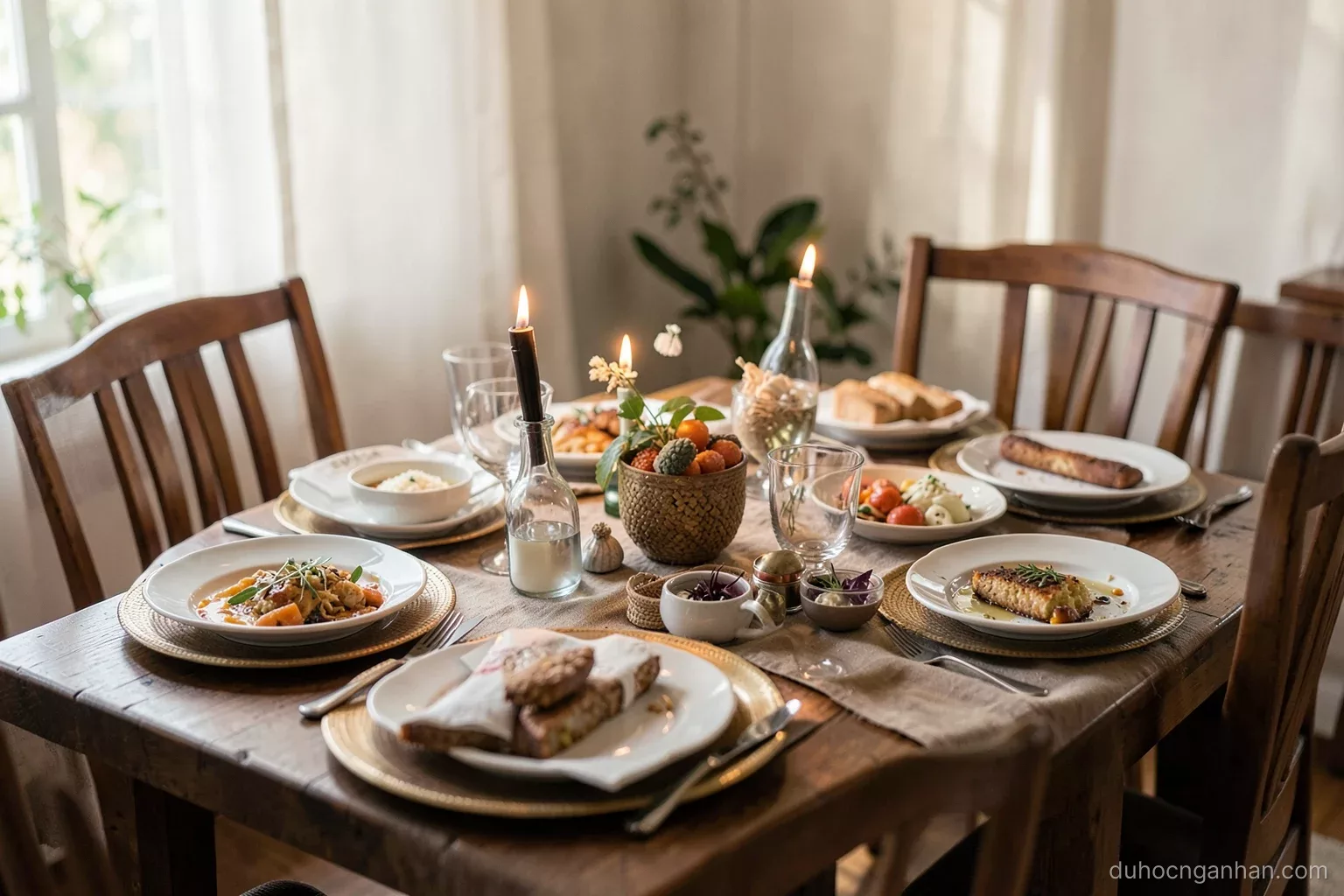
When your child stays with a local family for a few weeks, what makes a good stay is not a nice room or delicious food, but your child understanding the unwritten rules of that household — mealtimes, shower times, curfew, chores, how shared things are used — and knowing to ask rather than guess. Most friction between pupils and host families comes from small things nobody mentions: showering too long, not saying they will be late, staying shut in their room, not eating without explaining why.
This article does not discuss choosing a family or accommodation standards — that belongs to the stage of choosing a programme. It is about life inside the house: what your child should do on the first day and in the first week, how to speak up when unhappy, and how to say goodbye so the relationship continues after the trip.
The first dinner: ten questions worth asking
The very first evening, while everyone is still getting acquainted, is the easiest time to ask. Your child can bring a slip of paper with the questions written down so as not to forget:
- What time do you usually have breakfast and dinner? Do I need to let you know in advance if I won't be eating at home?
- What should I call you — by your first names, or something else?
- When is the shared bathroom busiest? How long should each shower be?
- How do I do my laundry, on which days, and can I use the washing machine?
- Can I help myself to food and drinks from the fridge, or should I ask first?
- What time do I need to be home in the evening? If I'm late because of a school activity, how should I let you know?
- Are there any areas of the house I shouldn't go into?
- What is the Wi-Fi password, and is there a time when the internet is switched off?
- What can I help with around the house: clearing the table, washing up, taking out the rubbish?
- If I feel unwell at night, whom should I call?
These ten questions sound like formalities, but asking them shows the hosts that your child respects their household's ways. Families who have hosted pupils for many years will often tell you in advance; then your child just needs to note it down and ask about anything unclear.
Differences in daily life that often cause friction
Every country is different, and every household even more so. The table below gathers the points Vietnamese pupils most often stumble over, so your child knows what to watch for — not to apply it as true for every home.
| Small matter | The habit at home may be | The hosts may think | The safe approach |
|---|---|---|---|
| Showering | Long showers, showering twice a day | It uses up the hot water, and the next person has none left | Ask about shower times, and shower within the agreed time |
| Staying in your room | Going straight to your room, shutting the door, using your phone | You don't want to be close to the family | Sit in the living room at least after dinner and talk about your day |
| Declining food | Leaving what you don't like without saying anything | You dislike their cooking, or you are unwell | Say gently: this dish is new to me, could I have just a little? |
| Coming home | Messaging once you are already late | Worry, and a feeling of not being respected | Let them know before you are late, not afterwards |
| Shoes, belongings | Keeping shoes in the bedroom, drying clothes in the room | Some homes are not used to shoes indoors or clothes drying in rooms | Ask where to put shoes and dry clothes on the first day |
| Thanks | Rarely saying thank you to people at home | You are not grateful | Say thank you after every meal and every time you are helped |
The column "the hosts may think" is not there to make your child worry, but to help them understand that the same action can be read in a completely different way. When unsure, saying it in one short sentence is always better than silence.
The first week: why silence is a trap
Vietnamese children are taught "when you're in someone else's home, don't be a bother". In many countries, silence is not understood as politeness but as distance or unhappiness. A pupil who does not say they are cold, hungry or tired may leave the hosts wondering all through the first week what they are doing wrong.
Your child does not need to talk a lot, just at the right moments. Dinner is the golden time: tell them about something that happened in class, ask a question about the food, ask how long the hosts have lived in the city. Short sentences such as "Today we went to the museum, it was interesting because…" are enough to keep a conversation going. If the hosts have young children, playing with them for ten minutes after dinner is the quickest way to connect without needing much English.
At the end of the first week, your child can take the initiative and ask: "Is there anything I should do differently?" A question like that opens the way for the hosts to give gentle feedback before small things build up into big ones, and shows your child is someone who listens.
When unhappy: how to say it without upsetting anyone
Separate what is uncomfortable from what is dangerous. Food that does not suit them, a room that is a bit cold, a house far from school — these are uncomfortable, and your child can tell the hosts themselves or tell the group leader so it can be adjusted. Being touched by someone in the house in a way that frightens them, being made to do excessive work, being left alone overnight, or being stopped from contacting their family — these are dangerous, and your child should tell the group leader or the person in charge at the school straight away, without negotiating.
Use "I feel" sentences. Instead of "the house is too cold", say "I feel a bit cold at night, could I have another blanket?". A sentence that starts with your own feeling makes the listener feel less blamed.
Suggest a solution. Hosts agree more easily when your child offers an option: "Could I take a shower in the morning instead?", "Could I buy some rice to cook myself on weekends?".
Tell the group leader early. If your child has spoken up and nothing has changed, do not put up with it until the last week. The group leader and the school's coordinator are responsible for mediating or changing the accommodation. If your child reports early, adjustments are easier for both sides.
Gifts for the host family: light, with a story, easy to use
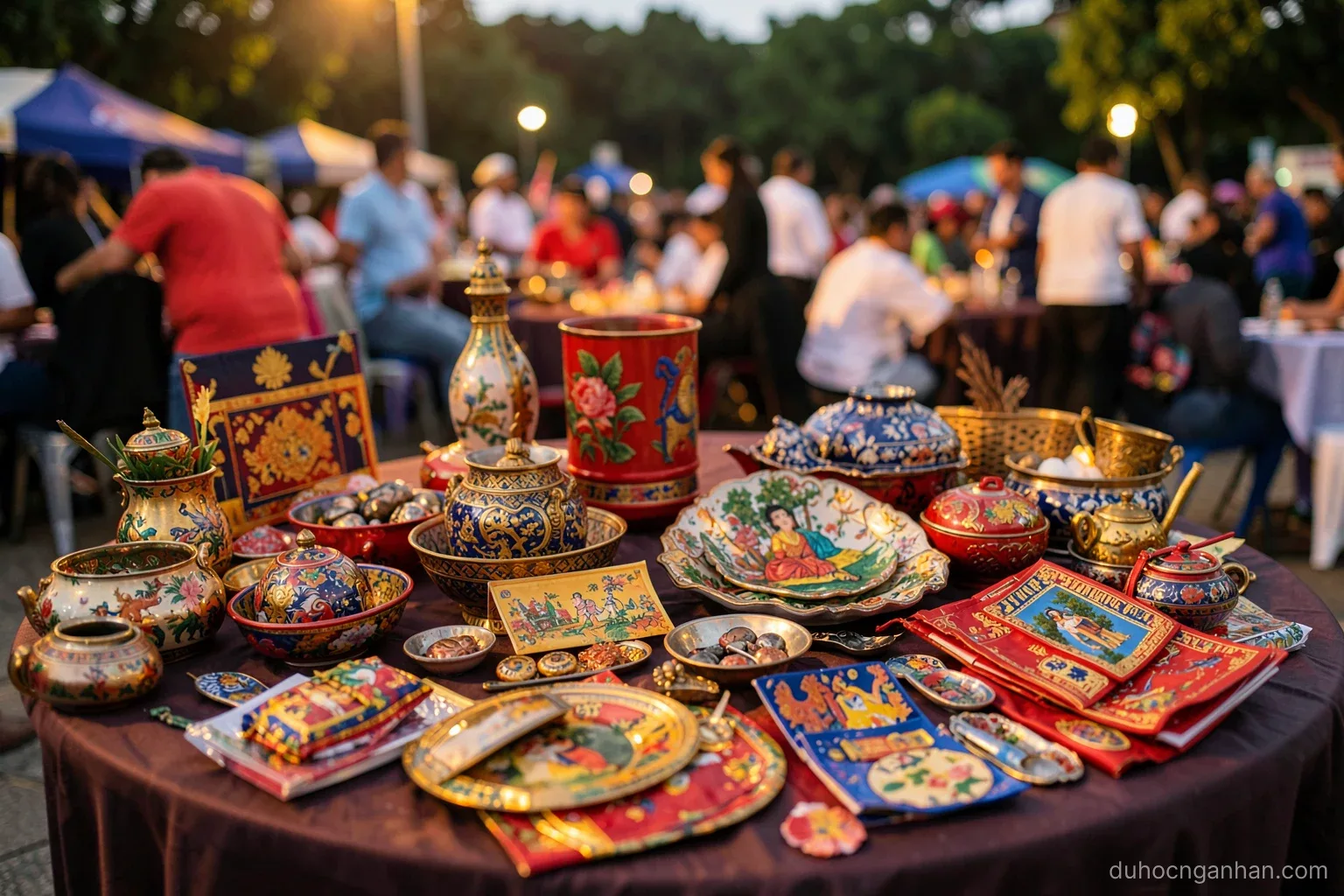
Gifts do not need to be expensive; what hosts remember is the story your child tells when giving them. A few suggestions that suit a pupil's luggage:
- A silk scarf, an embroidered cloth bag, small rattan or bamboo handicrafts — light, unbreakable, with a story about where they were made.
- A nice set of chopsticks with instructions on how to hold them, and then teaching the whole family to use chopsticks at one dinner.
- A small painting or a postcard of Vietnamese scenery, with a few lines your child writes in English.
- A foldable conical hat or a small water puppet for a home with children.
- Sealed packaged tea or coffee — but check the rules on bringing food into the destination first; some countries control food, seeds and dried goods very strictly.
- A dinner your child cooks: a simple Vietnamese dish such as fresh spring rolls or fried rice, made together with the hosts at the weekend.
Give the gift at the first dinner or a few days later once you know each other, rather than waiting until the day of departure. A small gift given at the start helps begin the conversation; a handwritten card left on the last day helps end it.
Things your child should not do, even if nobody forbids them
Some rules hosts do not write down because they think they are obvious. Your child does not invite friends home without asking. Your child does not use other people's personal things, including shampoo left in the shared bathroom. Your child does not take photos inside the house, especially photos with young children, and post them on social media without permission. Your child does not open cupboards or drawers outside their own room.
In many countries, knocking before entering someone else's room, even when the door is ajar, is essential. Talking loudly on the phone late at night, leaving the light on all night, or running the air conditioning with the window open are also habits that easily cause annoyance. Electricity, water and heating in many countries are a significant cost for a family, so your child should use them as carefully as they would at home.
Finally, your child should remember that they are a guest but also a temporary member of the family. Host families usually do not want to be served like a hotel, nor do they want your child to serve them. What they hope for is someone living with them who cares, asks, says thank you and tidies their own space.
When the host household's ways are completely different from your own
Local families are not like the image in films. Your child may stay with an elderly woman living alone, a retired couple, a single mother with two young children, an immigrant family that speaks another language at home, a vegetarian household, a household with three dogs. All are real families of that country, and all can be good accommodation if the organiser has checked them carefully.
Parents should prepare their child for this before leaving: not every home has a father, a mother and a child of the same age; not every home speaks English with a standard accent all the time; not every home eats meat at every meal. If there is something your child genuinely cannot cope with — an allergy to animal hair, a fear of dogs, a special diet — it must be stated clearly in the application so the organiser places your child in a suitable home from the start, rather than changing after arrival.
The remaining differences — the family talking more directly, eating dinner earlier, watching sport noisily all evening — are exactly the cultural exchange your child gets to experience. Your child does not have to like everything, just observe and ask why. Many pupils say that what they remember most after the trip are precisely the host family's habits that seemed strangest at first.
Saying goodbye and keeping in touch
On the last day, your child tidies the room as it was on arrival: folding the blankets, emptying the bin, returning the key, checking nothing like chargers or documents is left behind. A handwritten card describing a specific memory of the stay — the dinner when your child learned to cook their dish, the afternoon walking the family's dog — is worth more than any general thank you.
After coming home, your child can send a message saying they have arrived home, with a few photos taken together that the hosts agreed to. Three months later, a photo of your child studying, or greetings on a major holiday of that country, keeps the relationship warm. Many host families remember their pupils for years, and sometimes they are the ones who open up later opportunities for your child.
Parents can send a separate thank you through the organiser. Hosts very rarely receive feedback from pupils' families, so a few lines like this are usually received with great appreciation.
Frequently asked questions
If my child does not like the host family's food, what should they say?
Do not leave it in silence. Your child should say gently that the dish is unfamiliar to their taste, ask for a smaller portion, and suggest a solution such as preparing a simple breakfast themselves or cooking a Vietnamese dish together at the weekend. If after a week your child is still not eating enough, tell the group leader so it can be adjusted.
Do pupils in a homestay have to do housework?
Usually small tasks such as clearing the table, washing up, tidying their own room and taking out the rubbish — like a member of the family. Heavy or prolonged work, such as looking after children for many hours, cleaning the whole house or cooking for the whole family every day, is not part of a pupil's role; in such a situation your child should tell the organiser.
What should my child do if they feel unsafe in the host's home?
Your child should contact the group leader or the programme coordinator straight away on the emergency number they were given, without waiting until the next morning and without negotiating themselves. Parents should also tell their child that reporting such things is the right thing to do, and that the organiser is responsible for changing the accommodation when necessary.
Should we give the host family money when saying goodbye?
Usually not, because the host family has already received support through the programme, and cash may put them in an awkward position. A small gift from Vietnam, a meal your child cooks, or a handwritten card describing a specific memory is a more suitable way of saying thank you.
My child is homesick and wants to stay in their room calling home all the time. Is that a problem?
Calling home is normal, but if your child stays in their room every evening, the hosts may easily think your child does not want to be close to them, and your child misses the most valuable part of the trip. Agree a fixed call time with your child, and have them spend time after dinner in the living room with the family.
Can my child post photos of the host family on social media?
Only after asking and getting permission, especially for photos with children or photos inside the house. Many families do not want images of their home to appear publicly. Group photos taken as keepsakes are safest kept private or sent to the family themselves.