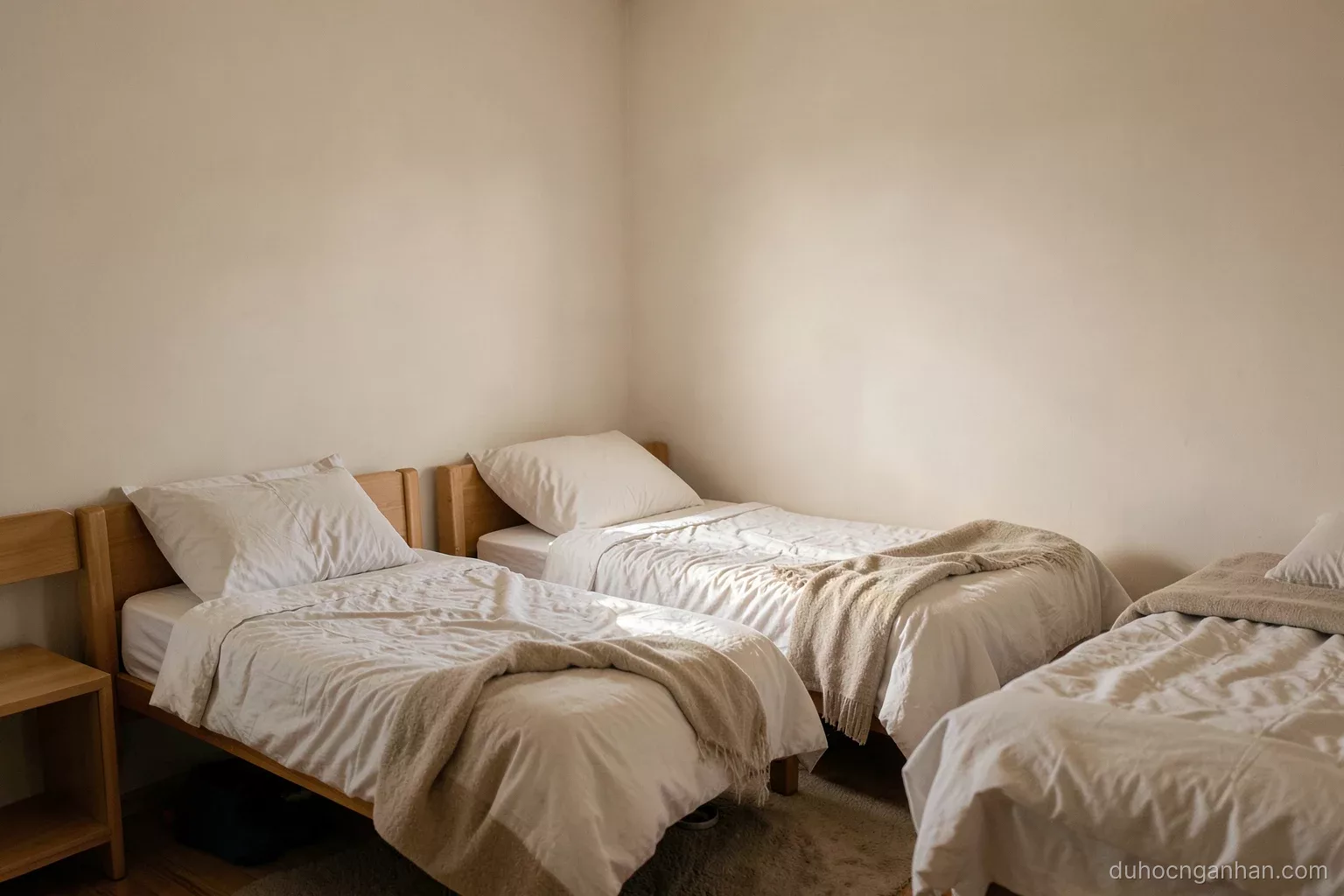
Sharing a room with a foreign friend at summer camp goes much more smoothly if, on the very first day, the two agree clearly on five things: bedtime and wake-up time, lights and air conditioning, shared belongings, visitors to the room, and how to tell each other when something is bothering them. Most conflicts in dormitory rooms come not from big cultural differences but from small habits nobody has mentioned.
For Vietnamese children, this is often the first time sleeping in the same room as someone who does not share their mother tongue for several weeks. This article helps your child prepare: the differences often met with friends from countries commonly found at Asian camps, a model room agreement, how to speak up when bothered, and the line between things to sort out themselves and things that must be reported to an adult.
Five things to agree on the very first night
On the first night both are still strangers and both want to seem easy-going, so it is the easiest time to talk. Your child can open with a simple sentence: "Can we talk about some room rules so we are both comfortable?" and then go through each point:
- Bedtime and wake-up time. Camps usually have a common lights-out time, but before that, who likes to read, who likes to sleep early, who sets an early alarm to exercise?
- Lights and air conditioning. What temperature is right, whether the fan stays on all night, whether the desk lamp can stay on when the other person is asleep.
- Belongings. Which things can be shared (toilet paper, hand soap) and which cannot (snacks, chargers, towels). Asking before using is the default rule.
- Visitors to the room. Until what time other friends can come in, and whether you need to ask the other person first. Many camps forbid pupils entering rooms of the opposite gender; that rule is not negotiable.
- How to remind each other. Agree that if either feels bothered, they will say so directly and gently within a day — not letting it build up, and not telling a third person first.
Some camps hand out room agreement forms; if not, the two friends can write a few lines on a sheet of paper stuck behind the door. Writing it down may sound formal, but it gives children who speak different languages a common reference to come back to when they misunderstand each other.
Common differences — and how to read them
Do not put every habit of a roommate down to nationality; every family has its own ways. The table below is only to help your child see that what seems "weird" to them may be normal in a friend's home.
| What your child may notice | A possible explanation | What your child can do |
|---|---|---|
| A friend showers in the morning instead of the evening | Family habit, the climate where the friend lives | Agree bathroom times so you don't clash |
| A friend takes off their shoes at the door and expects your child to do the same | In many East Asian countries, wearing shoes in the sleeping area is considered dirty | Leave shoes at the door; have separate slippers for the room |
| A friend prays at set times and needs a quiet corner | A daily religious practice, for example for a Muslim friend | Keep quiet for a few minutes, and do not walk in front of the friend while they are praying |
| A friend talks loudly on the phone with their family | The time difference, homesickness | Remind them gently, and suggest the corridor or the common room late at night |
| A friend rarely talks and wears headphones all day | Tired, shy about English, or just their personality | Invite them to eat together once, without pushing; give them time |
| A friend asks directly about things your child considers private | A more direct way of talking in the friend's country | Answer the parts you are comfortable with, and say gently "I prefer not to talk about that" for the rest |
What matters is your child's first reflex: ask "why" before concluding "they're weird". Most differences in a dormitory room turn into funny stories to tell once both sides are willing to ask each other a question.
Language in the room: English is a bridge, not a test
Many camps encourage or require English in shared areas. In the room, two friends of different nationalities naturally have to use English, and this is when your child practises speaking most each day without anyone grading them. Wrong sentences do not matter; unspoken sentences are what drive two people apart.
There are particular uncomfortable situations: a roommate talking on the phone in their mother tongue for hours, or two friends from the roommate's country coming in to hang out and talking in their own language, leaving your child sitting alone. Your child may also unintentionally do the same thing when Vietnamese friends drop by. A simple rule: when someone who does not understand is present, switch to the shared language, or briefly explain in English what the conversation is about.
For young children aged 9–11, gestures, card games, paper folding and watching a short video together are a more effective shared language than any conversation. Parents can let their child take a small pack of cards or a compact game to break the ice on the first evenings.
When something starts to bother your child: how to say it
Say it early, say it privately. Do not wait until your child is so annoyed they want to change rooms. The first time something bothers them is the easiest time to say it. Say it when only the two of them are there, not in front of other friends.
Talk about the action, not the person. "The light at midnight makes it hard for me to sleep" is much easier to hear than "You are so selfish". One sentence describing the specific action and how it affects you is enough.
Make a suggestion. "Could you use the desk lamp after 11?", "Can we keep snacks in your locker, not on my bed?". A specific suggestion helps the friend know what to do instead of just feeling blamed.
Accept giving up a little. A room agreement works both ways. If your child wants their friend to be quieter late at night, your child may also have to rustle less when getting up early. Children who learn this in a dormitory usually carry it with them for a long time.
Ask an adult when talking does not work. If your child has spoken up twice and nothing has changed, or does not have enough English to say it, they should ask the dormitory supervisor or the group leader. They have met these situations many times and know how to mediate without anyone losing face.
The line: things to sort out yourself and things to report straight away
Not everything in the room should be sorted out alone. Your child needs to know clearly the cases that must be reported straight away to the supervisor or group leader, without waiting and without negotiating: a roommate bullying, threatening, hitting or repeatedly taking things; a stranger or a pupil of the opposite gender entering the room against the rules; a friend bringing banned items such as cigarettes, alcohol or sharp objects; a friend showing signs of serious illness, harming themselves or saying things that make your child worry about their safety.
Vietnamese children are often reluctant to "tell on" someone, afraid of being seen as a traitor. Parents need to make it clear to their child before leaving: telling an adult about something dangerous protects both yourself and your friend; it is not telling tales. A good organiser will have a discreet procedure, so the person who reports is not subjected to retaliation.
With lost belongings, your child should report as soon as they notice, even if not sure who took them. Do not search a friend's things, and do not accuse without grounds. Valuables such as passports, large amounts of cash and spare phones are usually kept by the camp or in lockers; using those from the first day avoids most trouble.
Small things that make the room more pleasant
Each person's small habits decide the atmosphere in the room more than big conversations:
- Make the bed and gather dirty clothes into a separate bag every morning; a tidy room means fewer clashes.
- Do not eat strong-smelling food in the room; instant noodles, dried squid or dried durian can bother a friend all night.
- Wear headphones when watching videos, and put the phone on vibrate after lights out.
- Share a few of the Vietnamese snacks you brought, with a short introduction — many friendships begin with a packet of biscuits.
- Say "good night" and "good morning" every day, even if something unpleasant happened yesterday.
- Ask how your friend is when they seem sad or tired; a simple "Are you okay?" is enough to let them know someone notices.
Many pupils keep in touch with their roommates for years after coming home. What they remember is usually not the smooth days, but the time the two of them argued and then made up on their own.
Rooms and the formation of mother-tongue groups
At a camp with many pupils from the same country, mother-tongue groups form very quickly, and rooms are often where those groups gather each evening. If your child is the only Vietnamese pupil in a room with three friends from another country, your child may feel left out when the others talk in their language. Conversely, when your child's room becomes the meeting place for the Vietnamese friends, the foreign roommate may feel pushed out of their own sleeping space.
There is no need to ban same-language groups; they are a natural source of support, especially in the first homesick days. What is needed is a little awareness: the room belongs to two people, visitors should ask the roommate, and when a friend who does not understand is sitting there, switch to the shared language or bring them into the conversation. Your child can also invite their roommate to spend an afternoon with the Vietnamese group, and accept when the roommate invites them in return.
Experienced group leaders usually watch for signs of groups splitting off, such as one group always occupying an area, playing only with each other, or teasing other groups in their mother tongue. Spotted early, a few small changes in how activity groups are formed are enough to open up the atmosphere again.
What parents should do when their child calls home about a roommate
When a child calls home to complain that their roommate is messy, noisy or hard to get on with, many parents' reflex is to call the organiser straight away demanding a room change. Unless there are signs of danger, that usually takes away a valuable lesson from your child: negotiating with someone different from themselves.
Parents can ask their child three questions: what exactly is the problem, have you said anything to your friend yet, and what do you want your friend to change? Then work out a short English sentence together for your child to say. Arrange for your child to tell you how it went two days later. Most room issues are resolved this way, and your child comes home feeling they managed it on their own.
If your child describes things such as being hit, threatened, having things taken repeatedly or being deliberately isolated, parents should contact the group leader and the organiser straight away, noting the time and what your child said. That is no longer a cultural issue but a safety issue, and the camp has a responsibility to deal with it.
Frequently asked questions
Can my child choose to share a room with a Vietnamese friend?
It depends on the camp. Some camps let you register to share with a friend; others mix nationalities by default to increase interaction. Young children going far away for the first time may share with a Vietnamese friend for reassurance; older children should try a mixed room to make the most of the trip. Ask about the camp's rules before registering.
What if my child's roommate does not talk to them?
Give the friend a few days, as they may be shy about English, tired or homesick. Your child should greet them regularly and invite them to eat or play a simple game once, without pushing. If after a week the atmosphere in the room is still heavy, your child should talk to the supervisor for advice.
Should my child ask to change rooms as soon as they do not get on?
It is usually best to try talking and reaching an agreement first, because initial discomfort often eases after a few days. If talking has not helped, or there are signs of bullying or danger, your child should tell the supervisor or the group leader so a room change can be considered. Safety issues do not need to wait.
What should my child do if their roommate prays in the room?
Keep quiet for a few minutes, do not walk in front of the friend, do not touch the friend's prayer mat or prayer items, and do not film or take photos. If curious, your child can ask respectfully afterwards. Most friends will be happy to explain briefly.
How should my child handle losing something in the dormitory room?
First search carefully through their own things, then report to the supervisor straight away, even if they are not sure who took it. Do not search a friend's things, and do not accuse anyone. From the first day, passports, large amounts of cash and valuables should go into a locker or be left with the camp to reduce the risk.
How can I make sure my child does not only play with Vietnamese friends at camp?
Prepare a few opening lines and a small game in advance, agree with your child on a goal of talking to at least one friend from another country each day, and choose a camp that mixes nationalities in rooms and activity groups. Playing with Vietnamese friends is not wrong; just do not let it be the only option.