Before going to an English camp in the Philippines, your child should know a few cultural traits they will meet every day: Filipinos place great value on respect for elders (shown through the words "po" and "opo" and by calling people Ate and Kuya), lean towards keeping harmony within a group, rarely say a flat "no", and centre their meals on rice. Understanding these things helps your child greet people properly, read what teachers and staff mean, and avoid accidentally making someone lose face.
The Philippines is a country of many islands and many regional languages, with Filipino and English as its two official languages. At an English camp, your child will meet teachers, dormitory managers, canteen staff, security guards and drivers — mostly local people. The notes below are general tendencies, not a template for everyone; every region and every family is different.
Respect for elders: Ate, Kuya, "po" and "opo"
Ate and Kuya. Ate (pronounced roughly "ah-teh") means older sister, and Kuya means older brother. Filipinos use these two words not only within the family but also with strangers a little older than themselves: the woman serving in the canteen, the security guard, the driver. Campers who say "Ate" or "Kuya" with someone's name are usually received very warmly.
"Po" and "opo". In Tagalog, "po" is a particle added to a sentence to show politeness to elders or people who deserve respect, rather like the Vietnamese word "ạ". "Opo" means "yes" said respectfully. Your child can still speak English, but learning "Salamat po" (thank you, respectfully) will make people remember your child for a long time.
Mano. In many families, children greet grandparents, aunts and uncles by gently taking the adult's hand and touching it to their own forehead, a gesture called "mano". Your child does not need to do this with teachers at camp, but if invited to visit the home of a staff member or a local family and they see the children doing it, your child will know it is a gesture of respect and can join in if it feels natural.
Addressing teachers. At many English schools, students call teachers "Teacher" followed by their first name, for example "Teacher Anna". It is a familiar form of address, not a grammatical mistake, and usually more polite than using the first name alone.
Harmony in the group and how Filipinos say "no"
A concept often mentioned in discussions of Philippine culture is "pakikisama" — a spirit of getting along, keeping relationships within a group smooth. Alongside it is "hiya", a sense of shame or embarrassment at making oneself or others lose face in public. These two concepts explain many situations Vietnamese children easily misunderstand.
For example, when your child asks a staff member "could I change rooms?", the answer may be "I will try" or "maybe later" rather than "no". That is usually a gentle way of declining, not a promise. Conversely, teachers rarely criticise directly in front of the class; important feedback may be given privately or wrapped in praise. Your child should pay attention to small comments such as "you can try again this part" — that is the part that needs correcting.
This also means your child should avoid embarrassing others: not laughing loudly when a teacher pronounces a word differently from how your child learned it, not complaining about staff in front of many people, not pointing a phone camera at someone who is flustered. If something is not right, say so privately and gently, or ask the group leader to pass it on. Vietnamese people also value face, so this part is not unfamiliar; your child just needs to remember that it matters even more when you are a guest.
Meals: rice at the centre, inviting others to eat as courtesy
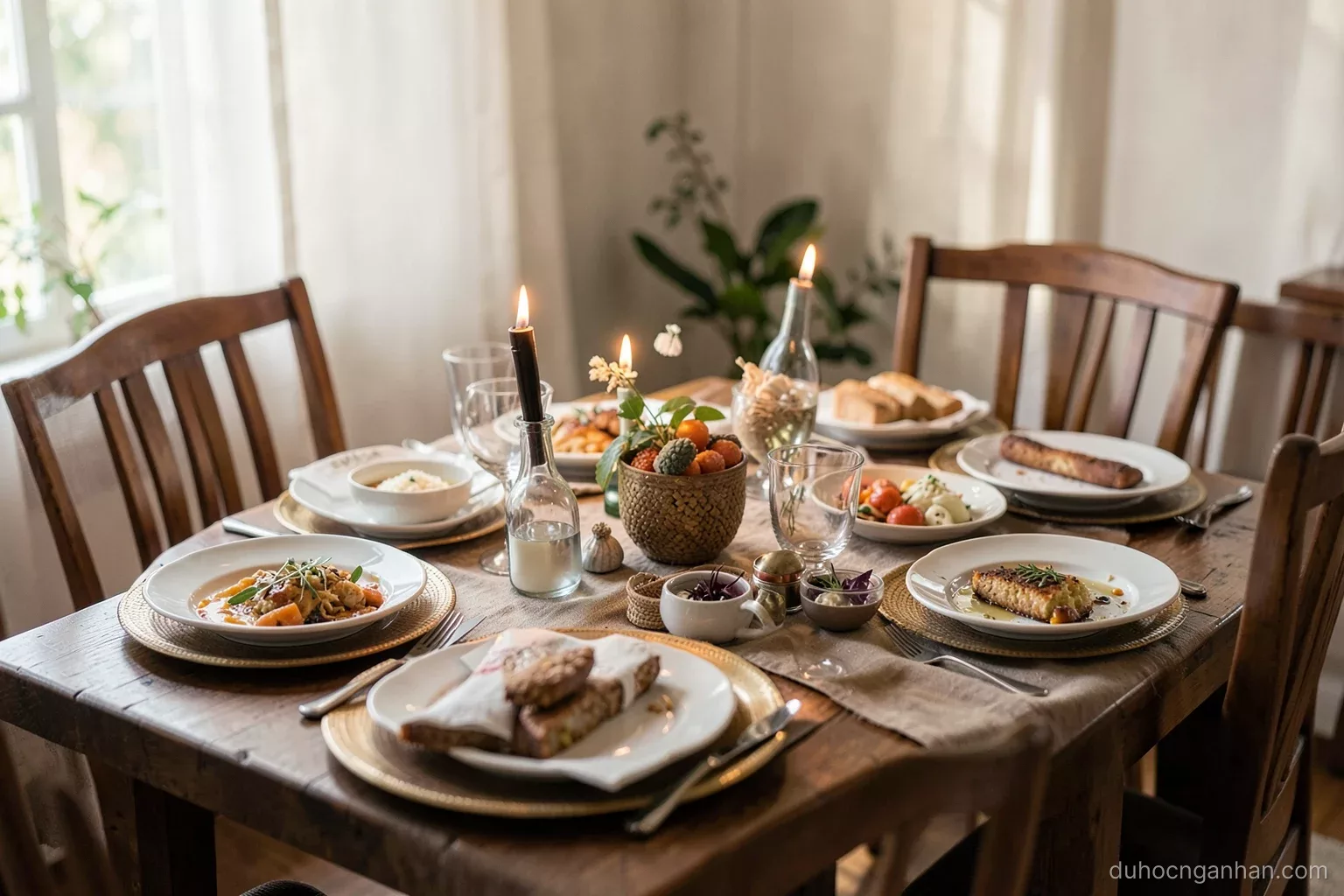
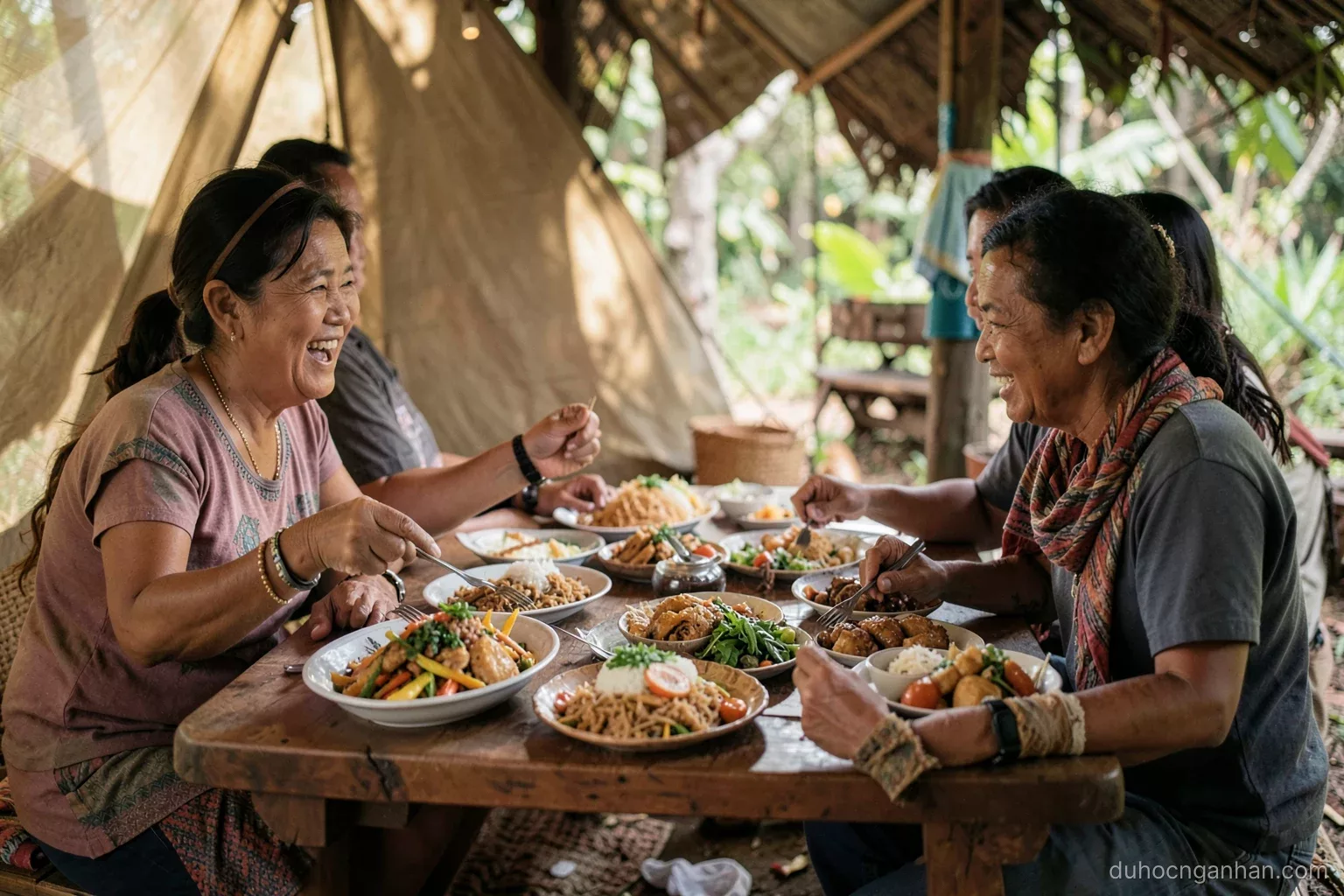
English camps usually have their own canteen, cooking a mix of Filipino dishes and dishes suited to Asian students. Even so, your child will meet local eating habits at parties, on weekend outings or when invited to someone's home.
| What your child will meet | Meaning | What your child should do |
|---|---|---|
| "Kain tayo!" (let's eat) | A social invitation to eat, even when the speaker is eating alone | Say thank you and smile; there is no obligation to sit down and eat |
| Rice with almost every meal, including breakfast | Rice is the main part; savoury dishes accompany it | Take just enough, and finish what you take |
| Distinctly sour, salty and sweet dishes: adobo, sinigang, grilled skewers | Flavours different from Vietnamese food: adobo has vinegar and soy sauce, sinigang is soured with tamarind | Try a small bite before taking a lot |
| Eating with a spoon and fork, spoon in the right hand | The fork is used to push food onto the spoon | No need to ask for chopsticks; most camps still have them if you ask |
| Eating with the hands from banana leaves (kamayan) at some parties | A festive, communal atmosphere | Wash your hands well, use your right hand, and take the food in front of you |
If your child has allergies or dietary restrictions, tell the camp in advance through the registration form and remind the canteen staff on the first day. Calling the woman serving "Ate" and saying "Salamat po" after every meal is a simple way of having one more person keeping an eye out for your child.
Faith and the rhythm of religious occasions in daily life
Most Filipinos are Catholic, and faith is very visible in daily life: a church at the centre of every town, statues and pictures of saints in shops, in jeepneys and sometimes even in offices. In the south, especially on the island of Mindanao, there are long-established Muslim communities. English camps usually do not include religious activities in the programme, but your child may see staff saying a short prayer before meals or going to church at the weekend.
Your child's job is simply to be respectful. When the whole table falls silent for a moment before a meal, wait with them and do not start eating first. When visiting a church on a weekend outing, wear a top with sleeves and trousers or a skirt below the knee, speak quietly, and do not take photos during a service. Do not joke about religious images, even if it is just fun among friends.
Major occasions such as Holy Week before Easter, or the Christmas season that starts quite early, may change outing schedules, shop opening hours and how crowded airports are. Your child does not need to remember the calendar, but should understand why on some days the streets are much emptier or much busier.
Small gestures and habits that are easily misunderstood
Raising the eyebrows or lifting the chin. Many Filipinos raise their eyebrows slightly to greet someone or to say "yes, that's right". It is not a sign of annoyance.
Pointing with the lips. Some people point in a direction by pursing their lips towards it rather than using a finger. If your child asks for directions and sees the person "pointing with their lips", go in that direction.
Beckoning with a finger. Crooking the index finger to call someone over is considered impolite in the Philippines, as in many other places. To call someone, raise your hand or wave with the whole hand palm down, or walk over and speak to them.
The "psst" sound. Local people sometimes call each other with a "psst" sound, especially to get a waiter's attention. Your child should not imitate this with teachers or adults; "Excuse me, Ate" is enough.
Punctuality. In social life, meeting times can be flexible, but at camp the timetable, roll calls and lights-out are fixed. Your child should not use "local people turn up late" as a reason for being late to class.
Preparing at home in the week before the flight
With just a few evenings, parents can help their child get familiar with the country they are going to, so the first days feel less overwhelming:
- Learn five Tagalog phrases: "Salamat po" (thank you, respectfully), "Magandang umaga po" (good morning, respectfully), "Opo" (yes, respectfully), "Ingat" (take care, also used to say goodbye), "Masarap" (delicious).
- Watch a few videos about Filipino food with your child and choose two dishes they want to try.
- Find the camp's location on a map: which city it is near, what the climate is like, and when the rainy season begins.
- Talk about the difference between Filipino teachers' English and the English your child hears in American or British films: a different accent, not a mistake.
- Prepare a small, light Vietnamese gift to give a teacher or a close friend at camp on the last day.
- Agree on how your child will dress on weekend outings: a top with sleeves for visiting churches, shoes for walking, and a hat for the sun.
These preparations will not make your child an expert on the Philippines, but they are enough for your child to begin with an attitude of curiosity and courtesy, which teachers and staff at camp usually notice within the first few days.
Filipino teachers: how they teach and how they praise
English teachers at schools in the Philippines are usually warm, patient and full of praise. For Vietnamese children used to strict teachers, this friendliness sometimes makes them overly casual: using teachers' first names alone, joking too much, asking teachers to do their work for them. Your child should remember that being friendly does not mean being equals; the teacher is still an adult who deserves respect.
Praise such as "very good" and "excellent" is very common and meant as encouragement. Your child should not rely on praise to judge that they are already good. A better approach is to ask: "What should I improve?" — teachers are usually pleased when pupils ask, and the answer will be more specific.
If your child is unhappy with a lesson, for example because the teacher is often late or the content is too easy, they should not say so directly in class but tell the academic manager or the group leader. This both saves the teacher's face and gets the problem genuinely resolved. Parents who hear about it from their child should also go through this channel rather than posting on social media.
Weekend outings: shopping centres, markets and the streets
Many English camps organise weekend outings to shopping centres, local markets, beaches or heritage sites. In the Philippines, large shopping centres are a shared space for many families: walking around, eating, escaping the heat, sometimes even attending Mass. At the entrance there are usually security guards checking bags; your child should open their bag for inspection without reacting, because it is a normal procedure for everyone, not one aimed at foreign visitors.
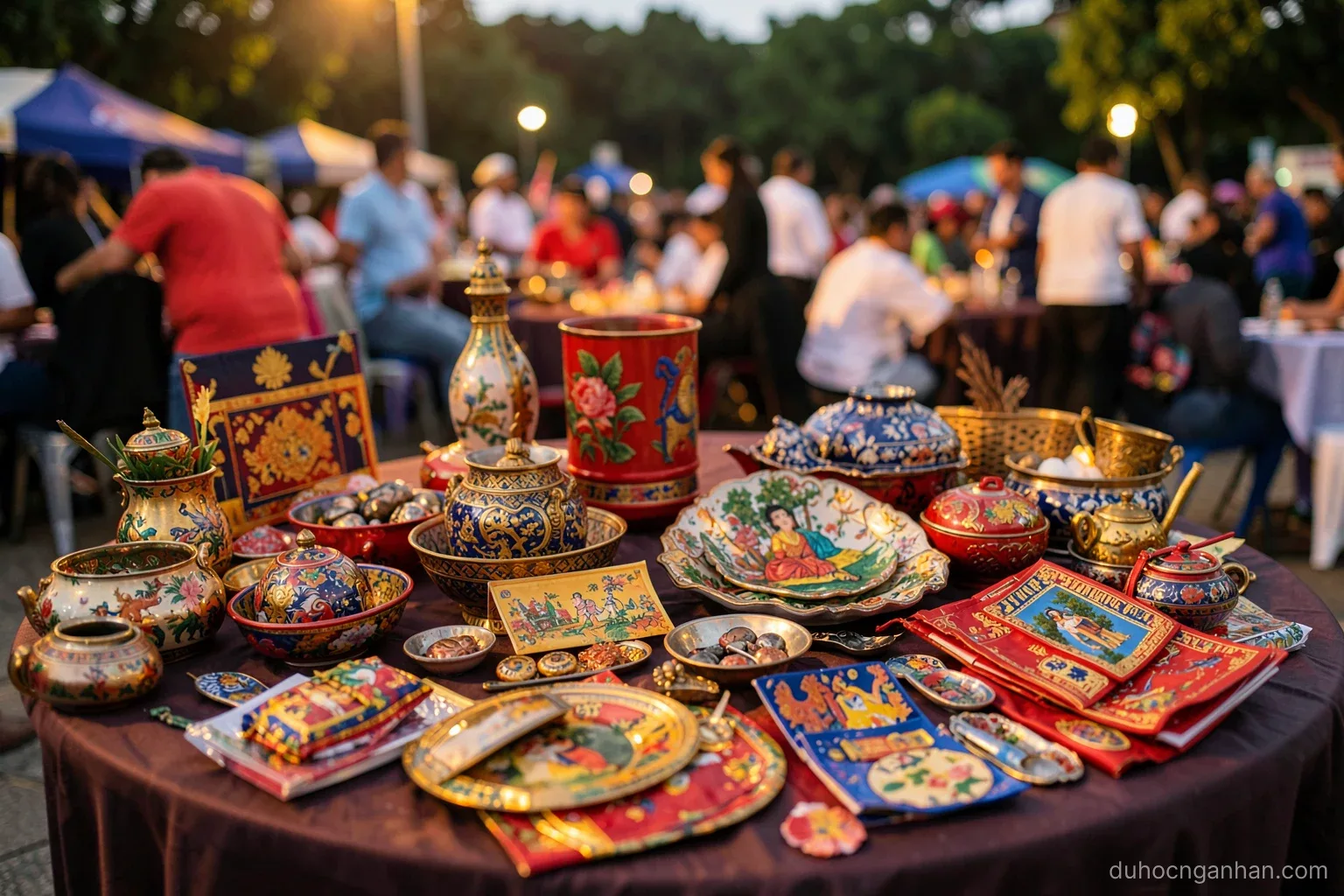
At markets and small stalls, gentle bargaining is sometimes accepted, but not in shops with marked prices. Your child should ask the price cheerfully, and if it does not suit them, say thank you and move on, without criticising the goods in front of the seller. Small change is best kept in a separate pocket; do not pull out a whole wad of notes in a crowd, and do not keep a phone in a back pocket.
On the streets, your child should always stay with the group and the guide, and not wander off alone to buy things or take photos. Vehicles such as jeepneys and three-wheeled tricycles are very distinctive and fun to watch, but pupils at camp only ride them when accompanied by adults and as part of the camp's plan. Your child can take photos of the streets, but when they want to photograph a particular person — a stallholder, a small child, an elderly person — they should ask first with a gesture or the question "May I take a photo?".
Frequently asked questions
Does my child need to speak Tagalog in the Philippines?
No. English is one of the two official languages and is widely used in schools, shops and airports. Learning a few Tagalog phrases such as thank you and good morning is just to show goodwill; local people are usually delighted to hear foreign visitors say a few words of their language.
Is calling camp staff Ate or Kuya considered too familiar?
Usually not. It is an affectionate yet polite form of address that Filipinos use with people a little older than themselves. With teachers it is better to say Teacher with their name, and with senior managers or much older people, Sir or Ma'am with their name.
If my child cannot eat Filipino food, will they go hungry?
Canteens at English camps usually cook many dishes familiar to Asian students, such as rice, stir-fried vegetables, soup and chicken. Your child should try unfamiliar dishes in small bites, tell the camp in advance about any dietary restrictions or allergies, and bring a little permitted dry food to tide them over in the first days.
When Filipinos say "maybe" or "I will try", does it mean yes?
Not necessarily. Because they value harmony, many people avoid saying "no" directly. "Maybe", "I will try" and "later" are in many cases a gentle refusal. If something is important, your child should ask again specifically — when, and who will do it — or ask the group leader to ask on their behalf.
What should my child keep in mind when visiting a church in the Philippines?
Wear a top with sleeves and trousers or a skirt below the knee, speak quietly, silence the phone, do not walk down the central aisle during a service, and do not take photos if there is a sign or someone asks you not to. Do not joke about religious statues or images. If unsure, your child should watch local people and do as they do.
Is Filipino teachers' English different from the English in American films?
It differs in accent and some word usage, as with every English-speaking region. Teachers at English schools are usually trained to pronounce clearly for teaching foreigners. Hearing many different accents helps your child get used to English as a global language, not the language of just one country.