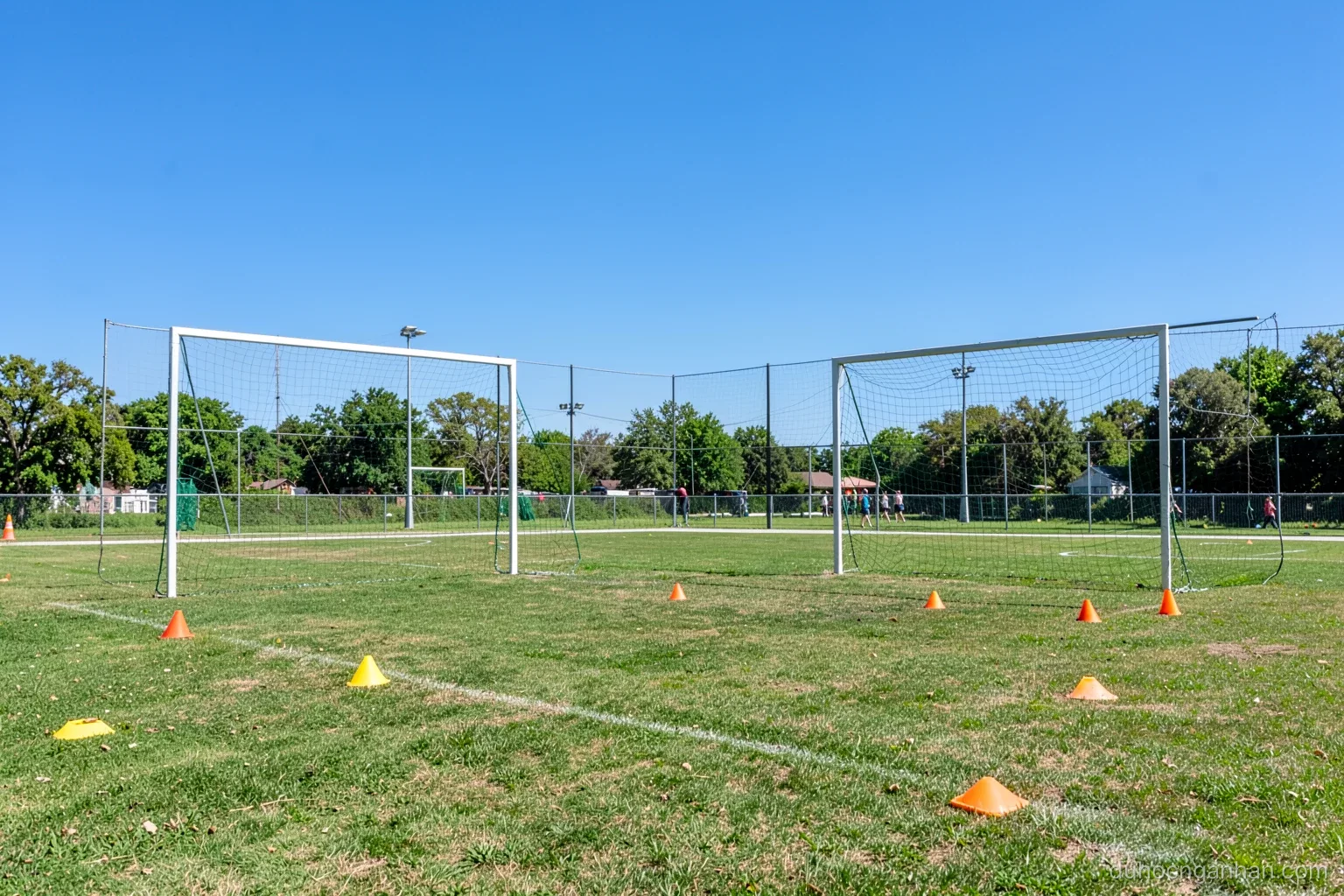
An international sports summer camp is a programme of one to four weeks abroad where most of your child's day goes on structured training in one sport, guided by specialist coaches, usually in two sessions a day, with rest, meals, recovery and shared activities in between. The most common sports are football, swimming, tennis, basketball, golf, horse riding and water sports such as surfing and paddling.
This kind of camp suits children who already play a sport regularly and want more structured training, or who want to try the training intensity of another country's sporting culture. Children who do not play any sport yet can choose "multi-sport" camps for beginners. The sections below cover how sports camps group pupils, what a training day really looks like, how much intensity suits each age, injuries, and the questions to ask before choosing.
Single-sport camps, multi-sport camps and language camps with sport
These three types are often all called "sports camps", but they differ greatly in intensity and in who teaches.
| Type of camp | Training time each day | Who teaches | Suits |
|---|---|---|---|
| Single-sport camp (academy) | Two sessions, many hours in total, with theory sessions and video review | Coaches qualified by that sport's federation | Children who have played for at least a year or two and want to improve technique |
| Multi-sport camp | One to two sessions, a different sport each day | Coaches and activity staff | Young children, children who have not chosen a sport yet, first-time campers |
| Language camp with sport | Language lessons in the morning, one training session in the afternoon | Language teachers in the morning, coaches in the afternoon | When the main goal is language, with sport for fitness and friendships |
If your child already trains at a club in Vietnam and expects to improve technically, a language camp with sport is almost certainly not enough; you need a single-sport camp. Conversely, putting a beginner into a high-intensity single-sport camp can easily exhaust your child and kill their enthusiasm.
What a day at a sports camp looks like
A day at a single-sport camp usually starts early to avoid the sun: a warm-up, a morning technique session grouped by level, with drills repeating one movement until it is right. Before midday comes rest and a meal. In the early afternoon, when it is hottest, many camps schedule indoor theory: reviewing training videos, learning rules, tactics and basic nutrition. The second training session usually leans towards game situations and practice matches. The evening is for shared activities with the whole camp.
A good camp has a rest day or a light training day each week, often linked to the weekend excursion. Children's bodies need time to recover; a weekly schedule with no light day at all is a sign to ask further questions. Many camps also have stretching, easy swimming or yoga at the end of the day.
In hot and humid countries, such as the Philippines or Southeast Asia in general, outdoor training is usually concentrated in the early morning and late afternoon, with indoor activities at midday. In temperate countries in summer, the days are longer and camps may train until the evening. This affects your child's bedtime and the times they can call home.
How much training intensity suits each age
Total organised activity each day. Camps for children aged 8–11 usually keep technique sessions short and broken up, interspersed with games. Camps for ages 14–17 may run much longer. There is no common figure for every sport; what to look at is whether the camp builds up intensity gradually during the first week or pushes hard from day one.
One single sport for many weeks. Paediatric sports medicine organisations in many countries recommend that children who have not yet reached puberty should not specialise in one sport too early and too heavily, because of the risk of overuse injuries from repeated movements. A summer camp of a few weeks is not the problem, but if your child already trains in one sport all year round, ask a doctor or their coach at home before enrolling in a high-intensity camp.
Temperature and drinking water. The camp needs a compulsory drinking schedule, shade, and a rule for stopping training when the heat exceeds a safe threshold. Ask the camp how it monitors the weather and who has the authority to stop a session.
Sleep. Children training twice a day need enough sleep. A room shared by many children, late lights-out because of evening activities, and jet lag in the first week can all leave your child short of sleep and more prone to injury.
Injuries, concussion and the camp's procedures
Minor injuries such as sprains, scrapes and strained muscles are common at sports camps. What parents need to know is how the camp deals with them: are there medical staff or people with first aid certificates at the pitch, are there cold packs and a first aid kit on site, how far is the nearest hospital or clinic, and who takes your child there if needed?
For contact sports such as football, basketball and rugby, the most important question is the concussion procedure. Grassroots sports guidance in many countries follows the principle "if in doubt, sit them out": a child showing signs after a blow to the head must leave the field, must not return the same day, and only resumes training after an appropriate assessment. A serious camp will have this procedure in writing and will inform the family immediately when an incident happens.
Parents should also declare the full history: old injuries, exercise-induced asthma, allergies, current medicines. If the camp does not know, it cannot prepare. Anything relating to your child's specific health should be discussed with your child's doctor before the trip; this article does not replace medical advice.
Water sports: what to ask separately
Swimming, surfing, kayaking and snorkelling are the most attractive sports in summer and also the ones that need the most careful checking.
- Does the camp hold a swimming test on the first day, and does the result decide which activities your child may take part in?
- Is there a dedicated lifeguard at the pool or on the beach, separate from the coach who is teaching, or does one person do both?
- What is the ratio of supervisors to pupils in open water (sea, lake, river), which usually needs to be tighter than at the pool?
- Are buoyancy aids compulsory for every activity on a boat, and are there sizes to fit young children?
- Who decides to cancel an activity when the waves are big, the wind is strong or there is thunder and lightning, and what does your child do instead?
- For scuba diving, what is the minimum age and which organisation issues the certificate? Many programmes only let young children try it in a shallow pool.
If your child cannot swim yet, say so honestly when registering. Many camps have beginner swimming classes and will not let your child into deep water until they pass the test. That is a way of protecting your child, not shutting them out of the fun.
Eating and recovery when training twice a day
Children training twice a day use far more energy than on an ordinary day, and camp meals are where parents have the least control. A well-run sports camp usually provides a breakfast with enough carbohydrates and protein, a snack before the afternoon session, fruit and water available at the pitch, and a dinner substantial enough for recovery. Camps where children choose their own food at a counter need adults keeping an eye on those who only eat bread or sweets.
Vietnamese children abroad for the first time often eat little in the first week because the tastes are unfamiliar, while the training schedule does not ease off. That is when they easily get tired, get cramps or catch minor illnesses. Parents can help in advance by introducing a few basic Western dishes at home, telling your child to eat enough even when the food is not appetising, and informing the camp of any foods your child avoids because of allergies or other reasons. Some camps let pupils bring a little familiar dried food; others ban it completely for hygiene reasons and because of roommates' allergies — ask in advance so it is not confiscated at the door.
Recovery also includes sleep, stretching and light afternoons. If your child tells you they go to bed very late every night because of what goes on in their room, that is more worth reporting to the group leader than the food.
Choosing a sports camp: the steps a family should take
The order below helps you avoid choosing a camp by the name of a famous club or by pictures of its facilities.
- Ask your child's coach at home about their level. The person who teaches your child every week knows what they need: basic technique, fitness or match experience.
- Choose the type of camp to match that goal. A single-sport camp for technique, a multi-sport camp for experience, a language camp with sport for language.
- Ask how groups are formed. Is there an entry assessment, how many children are in a group, and how many children does one coach look after on the pitch?
- Read the weekly curriculum. Which parts are technique and which are practice matches, is there a rest day, are there theory sessions?
- Ask about medical care and the weather. Who gives first aid, what is the concussion procedure, how are training times adjusted to the temperature?
- Ask about the rest of the day. Where does your child stay, what do they eat, what happens in the evenings? A sports camp is still a residential camp; daily life matters as much as training.
Do not be afraid to ask a lot. Sports camps with real expertise usually answer these questions quickly and concretely, because it is what they do every day.
What your child brings home after a season at a sports camp
One season of camp is not enough for a leap in technique, but it usually gives your child a few things that are hard to get at home: having their movement corrected by someone with a different eye, seeing how seriously children of the same age in other countries train, and getting used to following instructions and playing as a team in English. Many children come home training more willingly because they have seen a new standard.
Ask your child what the camp coaches corrected for them, and share it with their coach at home. Some camps send written comments or videos at the end of the course; these are valuable for the whole following year of training. Avoid comparing your child with friends or asking "were you picked for a team?"; a summer camp is for learning and fun, not for selection.
Once the family is clear about what your child needs from a season at a sports camp, the Du Học Ngắn Hạn advisers can send the weekly curricula, grouping arrangements and medical procedures of the camps currently taking registrations, so the family can read them against the questions above before discussing dates and length.
Frequently asked questions
Should my child go to a sports camp if they do not play any sport yet?
Choose a multi-sport camp or a language camp with sport, where your child tries a different sport at introductory level each day. After the camp, your child may know which sport they want to continue at home. High-intensity single-sport camps are for children who already have a foundation.
Do sports camps accept children with asthma?
Many do, if the condition is under control and the camp is fully informed, with a medication plan from a doctor. The family should ask your child's doctor first, bring enough medicine and documents, and ask the camp who keeps the reserve medicine while your child is on the pitch.
Will the camp let my child play real matches?
Most have practice matches within groups and friendlies between groups or with other camps at the weekend. Few summer camps enter children into official competitions. The aim is to apply skills in real situations, not to win titles.
Should my child bring their own equipment or use the camp's?
Training shoes that fit and are already worn in should almost always be your child's own, because new shoes easily cause blisters. For rackets, clubs and personal protective gear, ask the camp; many camps lend them, but children used to their own equipment usually train more comfortably.
What if my child gets injured in the middle of camp?
The camp gives first aid, takes your child to a doctor if needed and informs the family according to the agreed procedure. With an injury that means stopping training, your child usually stays at camp and takes part in light activities. Travel insurance with medical cover is a must before departure.
Do sports camps include English lessons?
Single-sport camps usually have no language classes, but all instructions and daily life are in English, so your child uses the language all day. If the family wants formal language lessons too, choose a language camp with sport or ask whether the camp has a morning language block.