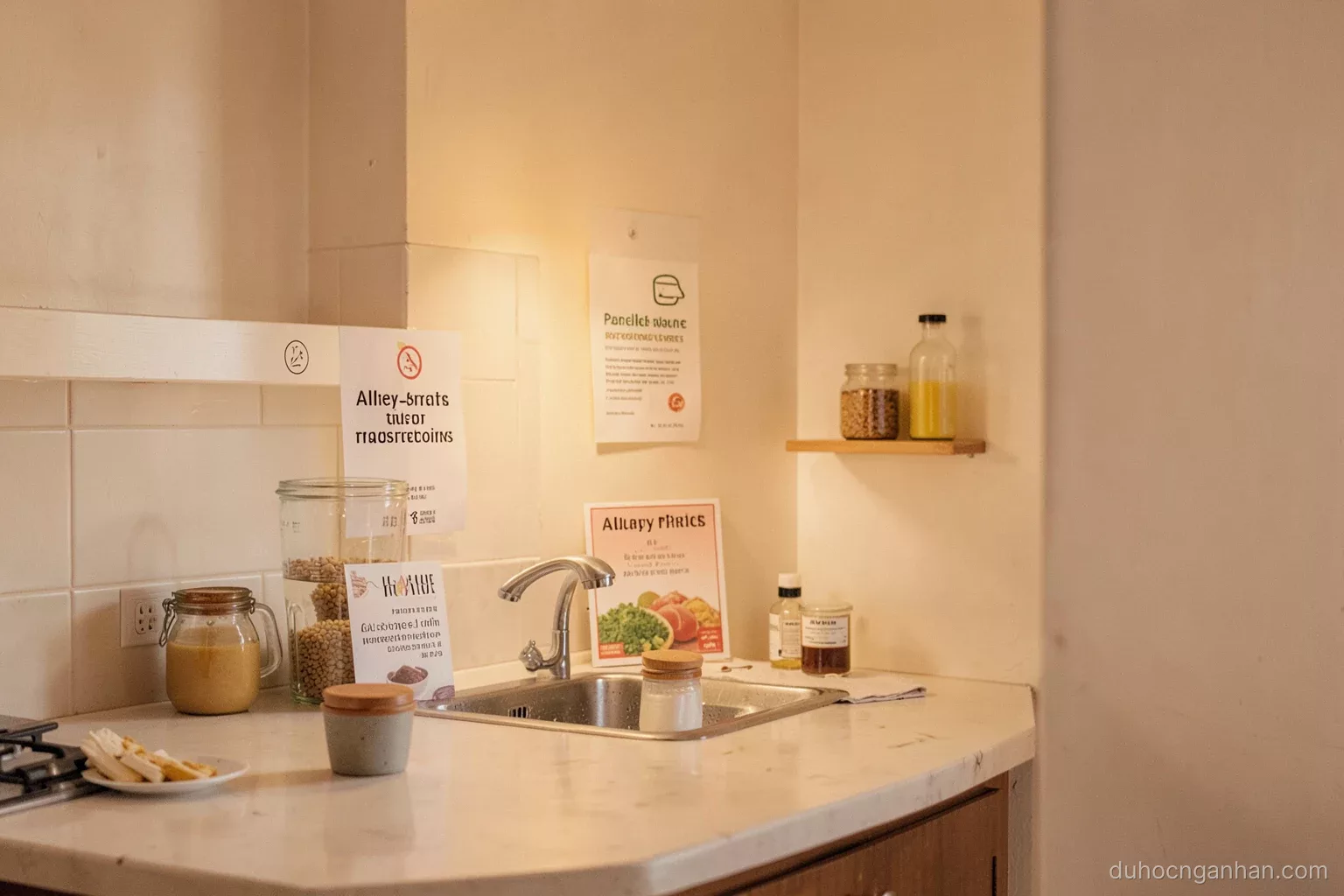
A child with a food allergy can still go to summer camp abroad, provided the camp kitchen knows exactly what your child is allergic to, has a way of keeping your child's food separate and safe, the adults around your child can recognise signs of a severe reaction, and the emergency medicine prescribed by the doctor is always close to your child. These four things must be confirmed before registering, not left until the first day in the canteen.
The difficulty abroad is not that food is more dangerous, but that your child loses the things that protect them at home: mum knows which dishes are safe, grandma cooks separately, your child can read ingredients in Vietnamese, the stallholder knows them by sight. At camp, your child eats unfamiliar dishes with unfamiliar names, cooked by people who speak another language, in a noisy canteen. This article goes through those gaps and how to close each one.
Why allergies are harder to manage at camp abroad than at home
The first reason is unfamiliar food. A child with a peanut allergy in Vietnam has learnt to avoid sticky rice with peanuts, peanut brittle and dipping sauces with roasted peanuts. In another country, peanuts may be in the thick brown sauce of a stew, in a crispy batter, in afternoon biscuits that nobody mentions. Your child does not carry in their head a list of dangerous dishes for the place they are going.
The second is language. Canteen staff often speak just enough English to greet people, but "does this dish share frying oil with shrimp?" is a hard question even for people who speak English well. It is even harder for an eight- or nine-year-old to ask, and they are often too embarrassed in front of friends to ask at all.
The third is the style of service. Many camps serve buffet style: trays of dishes next to each other, serving spoons moving between trays, children helping themselves. This is convenient for large numbers but is where cross-contamination happens most easily. Beyond the canteen there are snacks from friends, birthday parties in rooms and food to try on weekend outings.
The fourth is that a reaction may come when your child is not with anyone familiar. At home, if your child has symptoms, the parents see straight away. At camp, your child may be on the sports field, in their room in the evening or on a coach for an outing. A good allergy plan must cover those moments too, not just mealtimes in the canteen.
Ingredients often hidden in camp food
The table below gathers some examples of allergenic ingredients often hidden in dishes in places where Vietnamese children commonly go on short camps. It is a prompt so parents know what to ask, not a complete list:
| Place | Dish or type of dish | Ingredient easily overlooked |
|---|---|---|
| The Philippines | Brown-sauce stews such as kare-kare, some stir-fries | Ground peanuts or peanut butter in the sauce |
| The Philippines | Dips, stir-fried vegetables, fried rice | Fermented shrimp paste (bagoong), fish sauce |
| East Asia | Stir-fries, noodles, soups | Soy sauce containing wheat, sesame oil, toasted sesame seeds, dried seafood in stock |
| Europe, the US, Australia | Baked goods, breakfast cereals, energy bars | Tree nuts, peanuts, milk, eggs; many products made on the same lines as nuts |
| Europe | Pasta with green sauce, salads | Pine nuts, cashews, cheese in the sauce |
| Everywhere | Fried food | Frying oil shared between shrimp, fish and vegetarian dishes |
| Everywhere | Bottled sauces, cream soups | Milk, eggs, wheat flour, seafood extracts |
The point of the table is not to forbid your child these dishes, but to put them on the list of questions for the camp kitchen and in what you tell your child. A professional kitchen will be able to answer each line, or say plainly that it is not sure and your child should avoid that dish. The second answer is also a good answer, because it is honest.
Questions to ask the camp kitchen before registering
Do not just ask "does the camp cater for children with allergies?". That question always gets a yes. Ask specific questions to see whether the camp has really done it:
- Has the kitchen catered for children with your child's specific food allergy, and how many similar cases were there last season.
- Is your child's food cooked separately and put on a separate named tray, or does your child choose from the shared counter.
- Who in the kitchen is responsible for the allergy list, where is the list displayed, and are new staff briefed on it.
- Does the kitchen share frying oil, chopping boards or serving spoons between dishes with and without the allergen.
- Can the weekly menu be sent to the group leader or parents in advance.
- Who prepares afternoon snacks, food on outings and camp parties, and do they follow the allergy list.
- Are camp staff trained to recognise severe reactions and to use emergency medicine according to the child's own doctor's prescription.
- How far is the nearest hospital with an emergency department from the camp, and who drives the vehicle there.
If the camp gives vague answers to most of these questions, that is important information to weigh up. For a mild allergy, a kitchen that can answer half of them may be enough. With a history of severe reactions, choose a camp that can answer almost all of them, and ask your child's treating doctor before deciding.
The allergy card and the file your child carries
An allergy card is a wallet-sized card with your child's name, what they are allergic to, how severe it is, the emergency medicine they carry and an emergency contact number. It should be in English and, if going to a non-English-speaking country, also in the local language. The wording should be short and specific: instead of "seafood allergy", write "allergic to shrimp and crab; can eat fish" or the other way round, because the kitchen needs to know exactly where the line is.
Your child keeps one copy in their wallet or pouch, one goes to the group leader, one to the kitchen and one to the camp's medical room. Keep a photo of the card on your child's phone. For young children, some families choose a medical bracelet stating the allergen; this helps strangers recognise it immediately when your child cannot speak.
Along with the card goes an allergy action plan written or confirmed by your child's doctor: which signs are mild, which are severe, which medicine to use when, and when to call an ambulance. This plan should be translated into English, signed by the doctor and kept in the health file held by the camp. A camp abroad cannot read a Vietnamese medical record, but it can read a short, clear one-page plan.
If your child has been prescribed an adrenaline auto-injector, ask the airline in advance about rules for carrying it in cabin baggage, ask the camp who holds the auto-injector and where, and make sure one always goes with your child on every outing away from the camp. How many auto-injectors to carry and how to use them is for the treating doctor to decide, not something to decide yourself.
Teaching your child to protect themselves at the table
Ask before eating, even when embarrassed. Teach your child one or two English sentences short enough to say when hungry and in a hurry: asking whether the dish contains what they are allergic to, and saying clearly that they have an allergy. Practise at home a few times, role-playing the server, so the sentences become a reflex.
If unsure, do not eat it. The simplest and most useful rule. Your child can go hungry for one meal and go back to eat the safe dry food the group leader keeps in reserve. Missing a meal is not as dangerous as trying something.
Do not accept snacks from friends when you cannot read the ingredients. Friends from other countries often share sweets and biscuits from home. Your child should have a polite way of saying no ready, and some safe snacks of their own to share back, so nobody feels rejected.
Tell your roommate. The roommate is the person next to your child late at night. They only need to know what your child is allergic to, where the medicine is and whom to call. Many children are reluctant to say for fear of seeming different, but a simple explanation is usually respected by friends.
Report immediately when something feels wrong. An itchy mouth or throat, a rash or nausea after eating means finding an adult straight away, not waiting to see if it passes. Tell your child that reporting early is never a nuisance.
When your child has a reaction: what the camp must do
A food allergy reaction may just be an itchy rash, but it can also progress to anaphylaxis, a whole-body reaction that needs emergency treatment. Common warning signs are difficulty breathing, wheezing, a hoarse voice, swollen lips or tongue, repeated vomiting, dizziness, pale clammy skin and drowsiness. These signs can appear very quickly after eating.
A prepared camp has a written procedure: whoever is near your child stays with them, someone fetches the emergency medicine, someone calls an ambulance, someone informs the group leader. The medicine is used exactly according to the plan your child's doctor has written. After emergency medicine has been used, children usually still need to be taken to hospital for observation, because the reaction can return after a while.
Parents are informed immediately while their child is on the way to hospital. At this stage, the most helpful thing parents can do is confirm the history, the medicines your child has used before and how long the previous reaction lasted, so the doctors there have more information.
After every reaction, however mild, work with the camp to find out what your child ate and how it got through. It might be bread toasted on the same tray as nut bread, or a dish whose recipe has just changed without the kitchen updating its records. Learning clearly from it matters more than blaming anyone, because your child will be eating in that canteen for many more days.
Meals away from camp: outings, parties and snacks
Many allergy incidents at camp do not happen in the canteen, where the kitchen knows the list, but elsewhere: food stalls at amusement parks, restaurants on excursions, a birthday cake a friend brings to the room, sweets swapped between countries at a cultural exchange evening. In these places, the people serving food do not know who your child is.
Before each outing, the group leader should know where lunch will be, whether there is a menu in advance, and bring a safe back-up meal for your child. On a full-day trip this is not an unnecessary detail: your child is hungry and tired, friends are eating, and it is very easy to try something without thinking.
The cultural exchange evening is a highlight of camp, when each country brings out its typical food to share. A child with an allergy can still take part fully if reminded in advance: enjoy the food with their eyes, ask friends about the dishes, introduce their own Vietnamese food, and only eat what an adult has confirmed. When prepared, your child feels they are taking part, not standing on the sidelines.
For young children, you can agree a simple rule with the camp: your child only eats what has passed through the hands of the group leader or the camp kitchen. Older children are given more say, but still keep to the rule "if unsure, do not eat it". An allergy is not a reason for your child to miss camp; it is a reason to prepare a little more carefully.
Frequently asked questions
Should a child with a severe allergy go to camp abroad?
This decision needs the opinion of your child's treating doctor, based on the severity of past reactions and what the camp can really do. Many children with severe allergies go to camp safely when the camp has clear procedures and emergency facilities nearby. If the camp's answers are vague, choose another programme or wait until your child is older.
Can the camp kitchen cook separate meals for my child?
Many camps can, especially residential camps with their own kitchen. Some can only do so for a few common allergies. Ask specifically where the separate meals are prepared, how they are labelled and who gives them to your child, then ask the camp to confirm it in writing in the registration file.
Should we send dry food with our child?
Yes, provided it meets the destination's customs rules and the camp's rules. A little safe dry food your child is used to gives them an option when a meal is uncertain. The food should be sealed and in date, with part of it kept in reserve by the group leader.
What should the allergy card say?
Your child's name, the specific allergen, how severe reactions are, the emergency medicine your child carries and where it is kept, and the names and contact numbers of the group leader and parents. Write it in English, adding the local language if needed, in short clear sentences. Ask a doctor or someone with good language skills to check the translation.
My child has no allergies but their roommate does. What does my child need to know?
Your child should know what the friend is allergic to, not bring food containing it into the room if the camp asks, and know where the friend's medicine is and whom to call if the friend feels unwell. It is a good lesson in living together and helping friends far from home.
My child has no allergies but is a fussy eater. Should we tell the kitchen?
Fussy eating does not need to be handled like an allergy, but note it on the information form so the group leader can check that your child is eating enough, especially in the first week. Diets for other reasons, such as vegetarianism, should also be reported in advance so the kitchen can prepare and your child does not skip many meals.