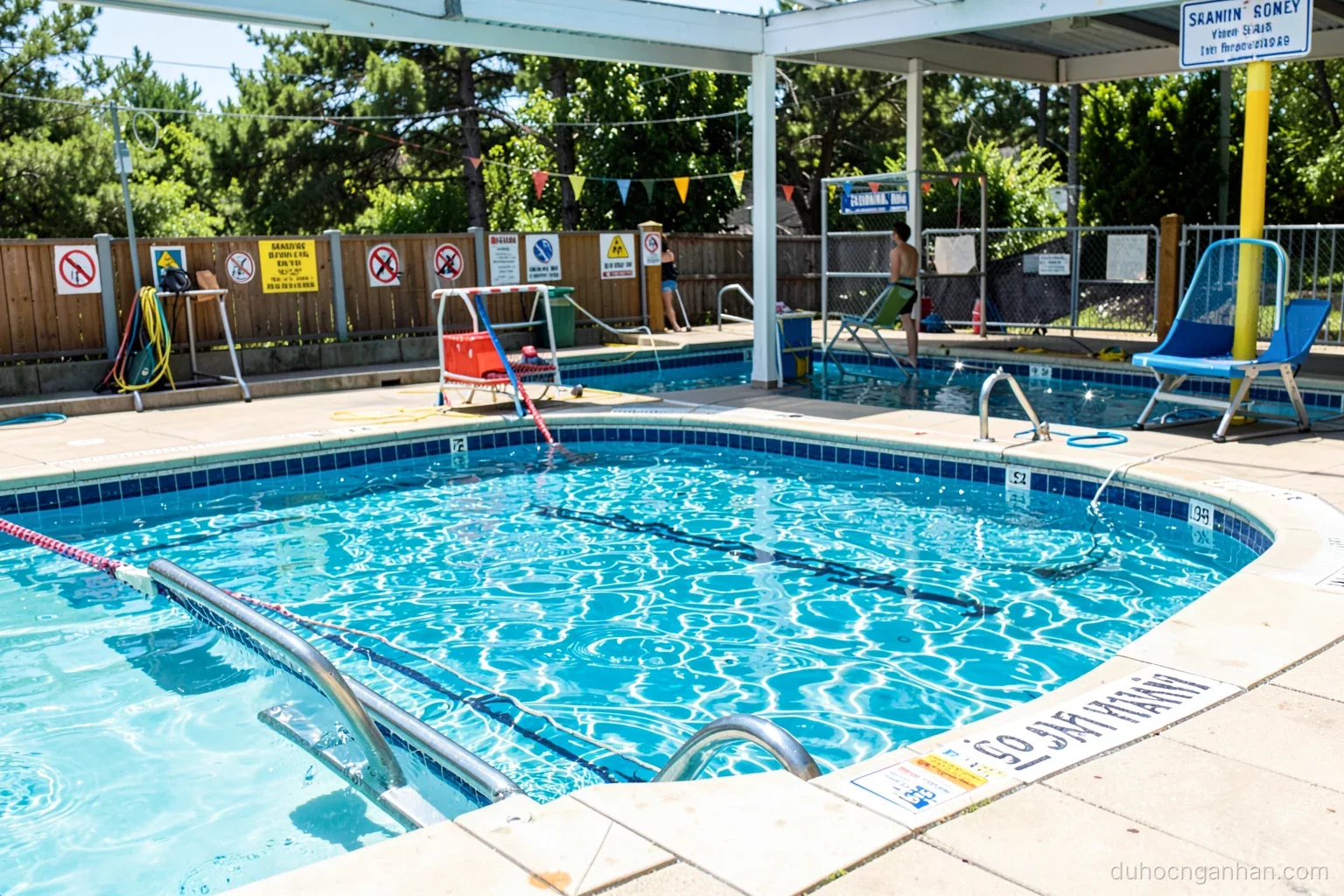
Swimming at an international summer camp is safe when four layers of protection are in place at the same time: your child's swimming ability is tested and they are assigned to a swimming area that matches their level, a certified lifeguard is always watching the water, children swim in pairs with a check-in and check-out, and every trip into the sea, a river or a lake has its own rules, stricter than at the pool. Missing one layer clearly increases the risk.
Drowning is one of the most serious risks for children and young people; the World Health Organization ranks drowning among the leading causes of death in this age group. Drowning also often happens silently, without the thrashing and shouting seen in films. So when choosing a camp, swimming is the part of safety most worth asking about in detail, even if your child can already swim.
Why children who can swim still need protecting
Being able to swim in a familiar pool where your feet touch the bottom is different from swimming in an unfamiliar deep pool, in the sea with waves, or when tired after a long day. Many children described by their parents as able to swim can actually only manage a few metres, or have never swum without someone standing beside them. At camp, your child is with friends and tends to push themselves, jumping from the side or swimming out into the deep end to follow others.
The body's condition matters too. A child who has just recovered from illness, is short of sleep, has just eaten a big meal or is dehydrated from the sun will be weaker than usual. In the tropics, the pool is where children most want to be on hot afternoons, exactly when many of them are tired.
Language is another factor. Lifeguards speak English or the local language and give instructions by whistle and gesture. In the first week, your child is not yet familiar with those signals. Some camps spend the first pool session explaining the rules and practising reacting to the whistle; that is a good sign.
None of this is a reason to ban your child from swimming. Swimming is one of the most enjoyable parts of summer camp. It is a reason for the camp to organise swimming systematically, and for parents to know where to ask. When all the layers of protection are in place, the pool becomes the place where your child has the most fun, makes friends fastest and visibly gains confidence after a few weeks.
The camp swim test: what it involves and what it means
Many international camps require a swim test in the first day or two, before letting children into the deep area. It usually involves swimming a continuous distance without holding the side, floating or treading water on the spot for a period, and getting in and out of the pool safely. The result is used to place your child in a group: shallow area only, allowed in the deep area, or allowed to take part in water activities outside the camp.
Some camps mark groups with coloured wristbands or coloured swimming caps, so lifeguards can tell from a distance which child is allowed in which area. It is a simple and effective approach, especially when the pool is busy.
Parents should be honest with their child and the camp about swimming ability. Being a weak swimmer is nothing to be ashamed of; record the correct level in the file so the camp can group your child sensibly. Some camps offer swimming lessons for children who cannot swim; that could be a worthwhile part of the camp season.
If the camp has no swim test at all and lets every child into the pool the same way, that is a question worth raising. Especially for beach trips or boating activities, the camp needs to know which children can swim and which cannot before getting on the coach.
Four layers of protection at the camp pool
A dedicated lifeguard. Someone with a lifeguard qualification, sitting where they can see the whole surface of the water, and not doing anything else such as minding belongings or playing with students. A large or busy pool needs more than one. A teacher watching from the side is useful, but cannot replace a lifeguard.
Clear opening hours and areas. The pool is only open when a lifeguard is on duty, and is locked or fenced outside those hours. Shallow and deep areas are separated by lane ropes. Rules against running on the side, diving into shallow water and pushing are repeated regularly.
Swimming in pairs and headcounts. Each child has a swimming buddy. When the lifeguard blows the whistle, each pair raises their joined hands, and anyone without a partner is spotted immediately. A check-in and check-out list makes sure no child is left alone at the pool after the group has gone.
Equipment and an emergency plan. Lifebuoys, rescue poles and a first-aid kit in easy-to-reach places; staff trained in CPR; who calls the emergency services and how an ambulance reaches the pool have been worked out in advance.
The sea, rivers and lakes on weekend trips
Natural water is much less predictable than a pool. The sea has waves, tides and rip currents, narrow strong currents that pull people away from the shore even when the surface looks calm. Rivers have undercurrents and uneven beds. Lakes can get deep suddenly and the water can be cold. That is why the rules for a beach trip must be stricter than for the pool.
A careful camp only lets children into the water at beaches with lifeguards and within marked areas, limits depth to chest or waist height for young children, counts heads regularly, and gets everyone out immediately when there is a storm, big waves or the beach lifeguards raise a no-swimming flag. Boat activities, kayaking and snorkelling all require properly fitted life jackets worn correctly, even for strong swimmers.
Tell your child one thing about rip currents: if carried out to sea, do not try to swim straight back to shore until exhausted. Stay calm, float, raise an arm to signal for help, and swim parallel to the shore to get out of the current before swimming back in. Many beach safety guides around the world teach exactly this.
One more rule to give your child: never go into the water without permission from an adult from the camp, even if a hotel or resort has a pool right next to the room. Many incidents happen in the evening, when a few friends sneak off for a swim outside permitted hours.
Preparing your child before the trip
The camp takes care of the system; the family takes care of your child's skills and understanding. A few things worth doing in the weeks before the flight:
- Let your child try swimming in a deep pool without holding the side, with an adult supervising, to find out how far they can really swim and how long they can float.
- Teach your child to float on their back and tread water on the spot; this is the most important self-rescue skill when tired.
- Teach your child to recognise a friend in trouble: drowning is usually silent, with the head tilted back, the mouth at water level, and no ability to call out.
- Tell your child that if they see a friend in trouble, they should call an adult and throw something that floats, and not jump in to rescue them unless trained.
- Record the correct swimming level and any history of epilepsy, asthma, heart conditions or other illness in the health file sent to the camp.
- Prepare swimwear according to the camp's dress code, goggles, a cap and water-resistant sunscreen.
If you can, a short water safety course for children at a pool near home in the spring is a worthwhile preparation. It not only teaches skills but also gets your child into the habit of listening to lifeguards, which they will need on the very first afternoon at camp.
When something happens in the water: what the camp does and how parents are told
Most incidents at a camp pool are minor: a child swallows water and panics, gets cramp, slips on the side or bumps heads with a friend. The lifeguard helps the child out, lets them rest, and medical staff check on them. These are usually recorded in a log, and the group leader may mention them in the daily summary.
For more serious incidents, where a child was pulled out after going under, lost consciousness even briefly, or keeps coughing or has difficulty breathing after inhaling water, the procedure must be first aid on the spot, calling the emergency services and taking the child to a doctor immediately, even if they seem to have recovered. Some complications after inhaling water can appear later, so doctors often want to monitor further.
Parents should be told the same day about any incident needing medical staff beyond simple rest, and immediately about any case involving a hospital. A good report states clearly what happened, where, who was supervising at the time, how your child was treated, and what the camp will change to prevent it happening again. If the report is just one vague sentence, parents have the right to ask for more.
After a frightening experience in the water, some children do not want to go back in. Do not push your child back in straight away to keep up with friends. Talk with your child, let them sit by the pool for a few sessions, then go into the shallow area with an adult they trust. Fear that is handled gently usually passes during the camp season.
Questions parents should ask the camp about water activities
These questions should be asked before registering, and the answers should be in writing in the programme documents:
- Does the camp have a swim test, what does it involve, and which activities can a child who has not passed it take part in.
- Is a certified lifeguard on duty at the pool throughout opening hours, and how many per shift.
- Is the pool locked or fenced outside opening hours.
- Where do trips to the sea, rivers and lakes go, are there lifeguards at the beach, and do students wear life jackets on boats.
- Are the staff travelling with the group trained in first aid and CPR.
- Can parents choose not to let their child take part in a particular water activity.
If your child has a health condition that affects swimming, parents have the right to ask that their child only uses the shallow area or does not take part in certain activities. A good camp will arrange an alternative activity so your child does not feel left out, such as acting as an assistant to the sports teacher or joining games on the side.
Frequently asked questions
Should a child who cannot swim go to a camp with a pool?
Yes, if the camp has a swim test and assigns swimming areas by level. Many camps have basic swimming lessons, which is a good chance for your child to learn. Parents need to state clearly in the file that their child cannot swim and confirm it again with the group leader before each beach trip.
Are life jackets necessary if my child is a strong swimmer?
Yes, for all activities on boats, kayaks or in deep natural water. Swimming well in a pool does not guarantee safety when a boat capsizes, after a collision, with cramp or in cold water. Life jackets must fit, be fully fastened and be checked by an adult before going into the water.
Do camps let children swim in the evening?
Some camps hold evening swims with full lighting and lifeguards on duty, as a special activity. What must be avoided is swimming at night without lifeguards, or children going swimming on their own outside permitted hours. Ask the camp how the pool is locked when closed.
Can a child with epilepsy or asthma swim?
This needs the opinion of your child's treating doctor. Many children with underlying conditions can still swim with closer supervision, such as always having an adult nearby or only swimming in the shallow area. State the condition clearly in the file so the camp can make arrangements; do not hide it for fear your child will be excluded.
Who is responsible if there is an incident in the water?
The specific responsibility depends on the contracts between the family, the organiser and the camp, and on the host country's law. That is why you need to read the safety and insurance clauses carefully before signing, and keep the camp's commitments on lifeguards and supervision in writing.
Should my child try scuba diving at camp?
Scuba diving requires separate training and certification, with age limits set by diving training organisations. Snorkelling in shallow water is easier but still requires a life jacket and an instructor. Parents should ask carefully before agreeing to let their child take part.